transport
infrastructure
economy
Transport satisfaction in the West of England
Negative perceptions of public transport in the West of England reinforce the region’s high dependency on private vehicles. But the region has scope to build a more reliable, affordable and sustainable public transport network that enables a shift away from private car use.
This policy insight examines the public perception of transport in the West of England region encompassing Bath and North East Somerset, Bristol and South Gloucestershire. It uses survey responses from IPSOS data collection and discussion of literature surrounding the importance of public perception in transport infrastructure policy.
What does the evidence tell us?
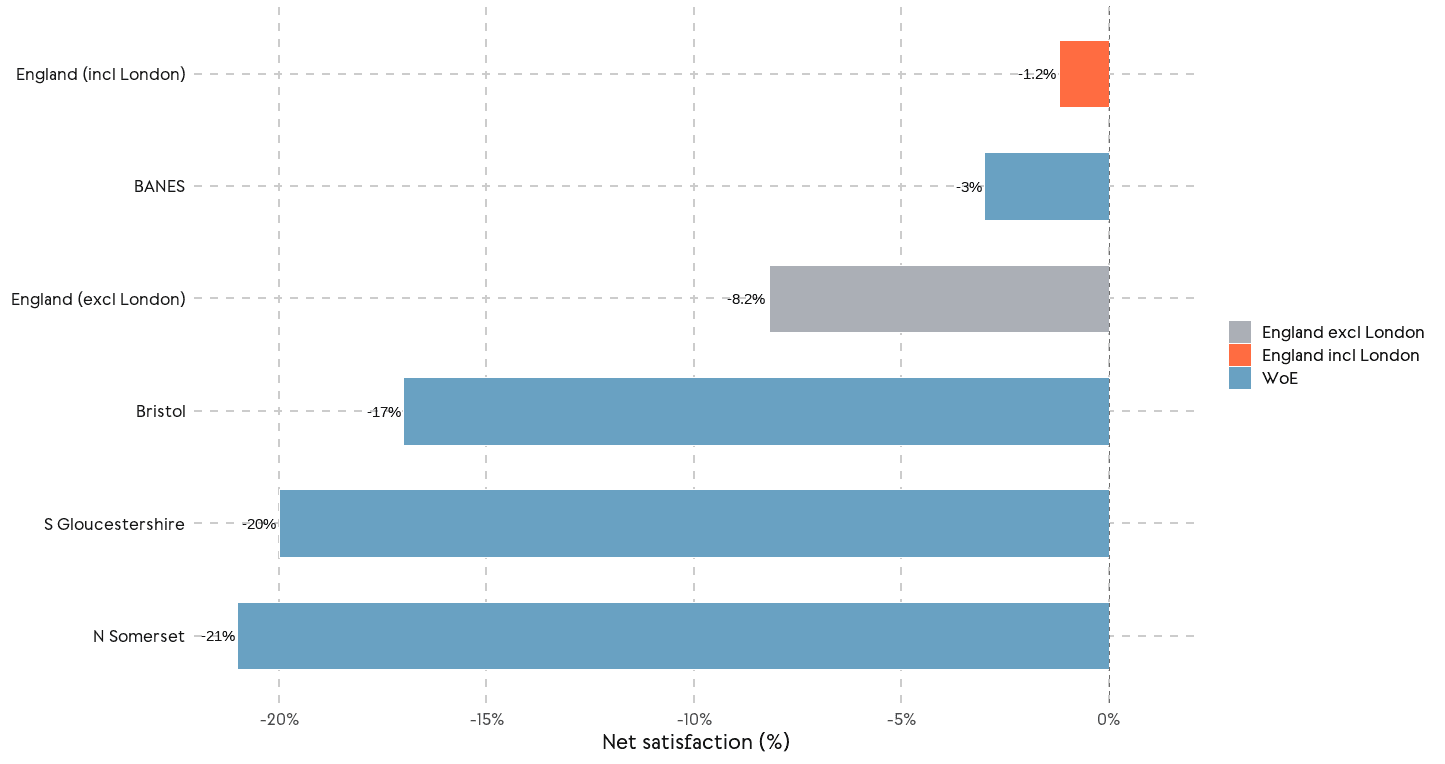
Satisfaction with public transport in the West of England is low. Although this is an issue seen across England, with a net negative satisfaction of -8% (excluding London), three of the four local authorities in the West of England report over double that figure. This is despite positive perceptions of job availability against the same national benchmarks.
Delays, uncertainty and poor reliability are undermining confidence in public transport. However, these issues also present opportunities for targeted interventions that could encourage shifts from private to public transport, improve access to employment, reduce car dependency, and help address congestion and pollution.
Why perceptions and satisfaction with public transport matter
Understanding the general perception of transport conditions matters because perceptions shape travel choices, route selection and long run residential and employment decisions. Travellers respond not only to travel times and objective transport conditions but also to their expectations about reliability, and the quality of the transport infrastructure (De Palma & Lindsey, 2011; Garcia-López and Gómez-Hernández, 2024). Such perception influences how people locate across space, contributing to patterns of urban development and the formation of labour and housing markets. Satisfaction is therefore a key mechanism that influences how transport systems shape economic activity, social inclusion, and mobility patterns.
Perceptions also play an important role in determining public and political support for transport policies, often mediating how individuals interpret the benefits and costs of infrastructure investments. The induced demand debate illustrates this clearly: travellers and policymakers frequently interpret changes in traffic volumes as evidence of worsening congestion, even when travel times and welfare may improve (Hymel, 2019). Similarly, perceived fairness and distributional impacts strongly influence attitudes toward congestion pricing, public transport funding, and low emission zones (Fosgerau & de Palma, 2013; Börjesson et al., 2017).
Transport policy must emphasize the need to also account for the users' satisfaction when assessing policy effectiveness. Recognising the role of perception enables a more accurate understanding of transport outcomes and helps design interventions that are not only efficient but also socially and politically feasible. This policy insight examines public perception of public transport in the West of England and some aspects that can improve perception and satisfaction in the region.
Public transport satisfaction in the West of England
Reducing dependency on cars in the West of England requires a public transport system that is perceived as reliable, cost competitive and convenient. Yet, residents in the West of England are dissatisfied with the quality of their public transport, according to Ipsos (see Figure 1).
Figure 1: Satisfaction with the quality of public transport
Source: Ipsos, 2025
Notes: Local authority figures averaged unweighted for England. Ipsos reports average margin of error ≈ 19% (range 15-32%).
BANES, Bristol, South Gloucestershire and North Somerset all have negative net satisfaction scores for public transport, placing the combined average for the region below national levels (1.2% for England including London and 8.2% excluding London). While dissatisfaction with public transport is widespread across the country, Bristol, South Gloucestershire and North Somerset perform noticeably worse than the England averages.
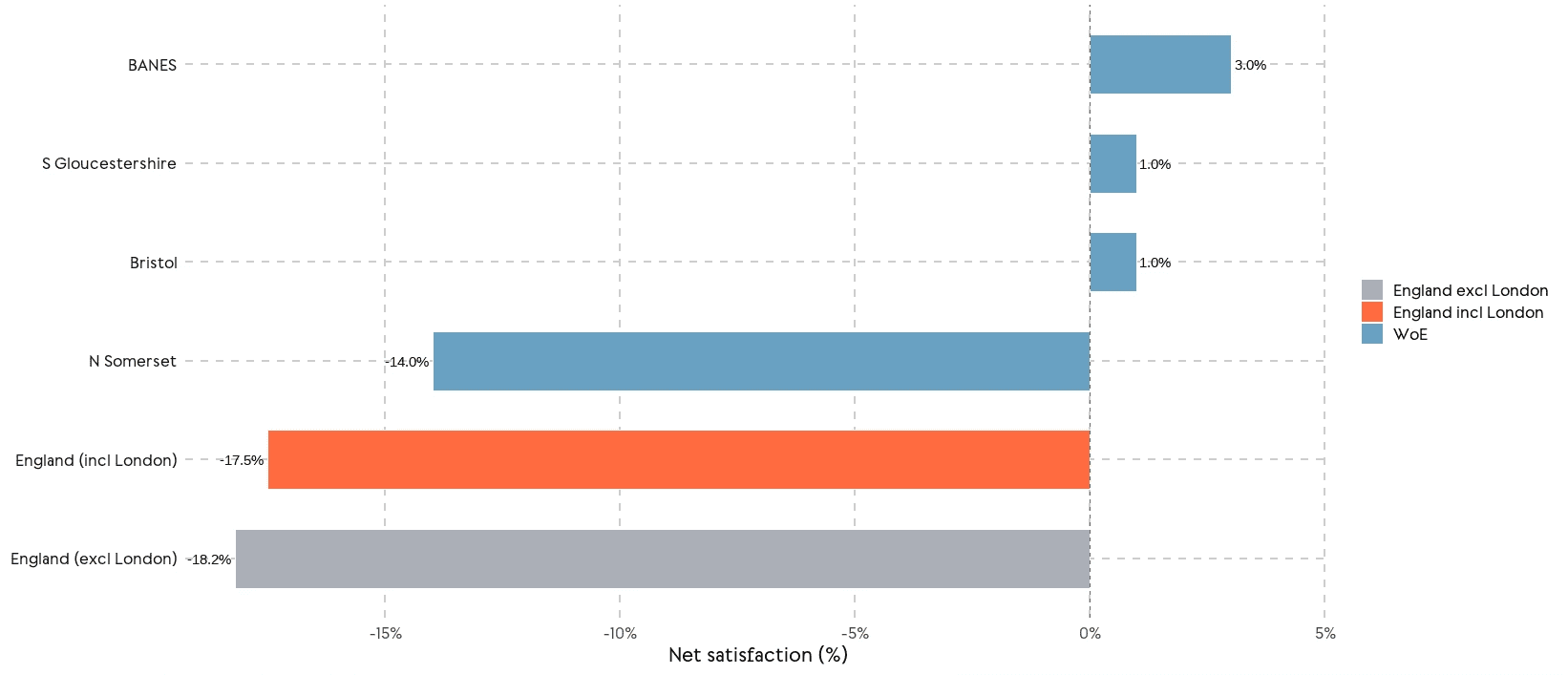
There is a clear contrast in how the region’s residents perceive public transport compared with job availability (see Figure 2). Looking at this comparison is important as accessibility to public transport infrastructure is closely linked with labour market outcomes. Low levels of public transport satisfaction typically signal a disconnect between people’s homes and workplaces, and often reflects limited access to employment. Such disconnects can have negative effects on social mobility and firm behaviour, as well as complicate transport investment planning.
Figure 2: Satisfaction with the availability of secure and well-paying jobs
Source: Ipsos, 2025
Notes: England figures are unweighted averages of local authority net percentages. Ipsos reports average margin of error ≈ 15% (range 11-23%).
Although the West of England faces transport challenges similar to, or, in some cases, worse than other parts of the country, local perceptions of employment opportunities are considerably more favourable. Most residents in the region report positive net satisfaction with job availability, with scores between +1% and +3%. Even in the case of North Somerset – where the perception is negative (-14%) – the score remains higher than the strongly negative national averages (-17.5% including London and -18.2% excluding London). This asymmetry between satisfaction around public transport and job availability is linked to the West of England’s relative economic prosperity, while simultaneously painting a clear picture of the region’s transport policy challenge.
Improving public transport perception and satisfaction
A transport system that keeps pace with the region’s growing economy would help to align public perceptions with the region’s strong employment prospects. When this alignment breaks down, as appears to be the case, public transport may limit residents’ ability to fully benefit from local economic opportunities. Strengthening public perceptions of public transport would, therefore, encourage workers to participate more dynamically in the labour market, generating wider economic gains in the long run.
Dissatisfaction with public transport quality can affect the willingness to use existing services, reinforcing the region’s reliance on private cars and contributing to high congestion levels. This helps to explain the West of England’s high congestion rates and its ranking among the worst areas in the UK for private car use (WECA, 2025a).
Transport also shapes population patterns and accessibility more broadly. Improvements in congestion due to increased public transport use could substantially expand the number of residents with reasonable access to key destinations. What’s more, reducing congestion could increase the number of people living within a 30-minute bus journey of Bristol city centre by around 150% (WECA, 2025b).
Improving public transport in the region is the first step toward strengthening public perceptions. There are several conditions for successful mass transit systems that are pertinent for improving perception and stimulating behaviour change in the West of England. First, public transport journeys must be faster than driving. Second, densely populated areas must be served. Third, public transport must reliably take people where they need to go (Brooks and Denoeux, 2022). These principles highlight issues of accessibility, reliability and network design – areas where the West of England continues to face challenges, and where perceptions reflect underlying service gaps.
Equity and inclusion matter as well. Transport satisfaction intersects with broader issues of transport accessibility. Across the region, service levels, affordability and socioeconomic exclusion align with measures of life satisfaction, education and financial stability (Williams Higgins et al., 2025). Addressing public transport service levels and affordability is essential to ensure that investments and improvements benefit all communities, including in rural areas.
Further, improving public transport reliability, safety and information provision is essential for building public confidence. WECA’s own assessments highlight persistent reliability issues. Only three‑quarters of buses ran on time in 2022-23, well below other regions and below WECA’s targets. Traffic delays, limited realtime information, inconsistent routes‑ and the problem of ‘ghost buses’ all undermine trust in the network (WECA, 2026). Safety concerns – particularly for women and girls at night – further discourage use.
Conclusion
Satisfaction with public transport in the West of England is low. Delays, uncertainty and poor reliability discourage use and undermine confidence. With high dependence on cars, improving perceptions of public transport is essential to encourage travellers to shift away from private vehicles, simultaneously helping to reduce both congestion and pollution.
Despite these challenges, the region has strong opportunities to expand mass transit, including through public-private partnerships. Improved reliability and greater affordability, for example via integrated ticketing, fare caps and targeted concessions are central to enabling change.
Local authorities can coordinate operators, engage communities and use digital tools to optimise services and align transport with both housing and climate objectives. While trade-offs remain, progress is already under way, and the region is well placed to build on this foundation.
References
Börjesson, M., Fung, C. M., and Proost, S. (2017). Optimal prices and frequencies for buses in Stockholm. Economics of transportation, 9, 20-36. Available at: https://www.sciencedirect.com/science/article/abs/pii/S2212012216300429
Brooks, L. and Denoeux, G. (2022) What if you build it and they don't come? How the ghost of transit past haunts transit present. Regional Science and Urban Economics, 94. Available at: https://www.sciencedirect.com/science/article/abs/pii/S0166046221000314
De Palma, A., and Lindsey, R. (2011). Traffic congestion pricing methodologies and technologies. Transportation Research Part C: Emerging Technologies, 19(6), 1377-1399. Available at: https://www.sciencedirect.com/science/article/abs/pii/S0968090X11000362
Garcia-López, M. À., and Gómez-Hernández, L. Y. (2024). Housing prices, buses and trams in Medellín (Colombia). Research in transportation economics, 106, 101464. Available at: https://www.sciencedirect.com/science/article/pii/S0739885924000593
Hymel, K. (2019). If you build it, they will drive: Measuring induced demand for vehicle travel in urban areas. Transport policy, 76, 57-66. Available at: https://www.sciencedirect.com/science/article/abs/pii/S0967070X18301720
Fosgerau, M., and De Palma, A. (2013). The dynamics of urban traffic congestion and the price of parking. Journal of Public Economics, 105, 106-115. Available at: https://www.sciencedirect.com/science/article/abs/pii/S0047272713001321
Ipsos (2025). Putting the Public in Public Transport. Report and data available at: https://ipsos-insight-llc.foleon.com/understanding-society/public-services-2025/transport
Garcia-López, M. À., Gómez-Hernández, L. Y., and Sanchis-Guarner, R. (2024). Highway traffic in Britain: The effect of road capacity changes. CEP Discussion Paper. Available at: https://cep.lse.ac.uk/_NEW/PUBLICATIONS/abstract.asp?index=11143
WECA (2025a). West of England Growth Strategy. Available at: https://www.westofengland-ca.gov.uk/wp-content/uploads/2025/09/Growth-Strategy-Web.pdf
WECA (2025b). State of the West of England in 2025. Available at: https://www.westofengland-ca.gov.uk/about-us/regional-insights/regional-evidence-report/
WECA (2026). West of England Transport Vision. Available at: https://www.westofengland-ca.gov.uk/wp-content/uploads/2023/07/WE4924-Transport-Vision-for-web_v3.pdf
Williams Higgins, M., Mukherjee, S. and Yin, Y. (2025) ‘Transport Inequality and Socioeconomic Outcomes in Bristol’, Bristol Transport Project. Available at: https://btrp.blogs.bristol.ac.uk/2025/08/29/transport-inequality-and-socioeconomic-outcomes-in-bristol/