inequality
health
skills
Health and social outcomes for children in the West of England
Inequality in the West of England is negatively affecting the readiness of the future workforce and long-term economic capacity. The spatial concentrations of early life disadvantage across the region risk’s compounding divergences in the economy.
This policy insight examines key indicators, including educational attainment, physical health and mental health, to assess the spatial distribution of opportunities for children in the West of England. These indicators are drawn primarily from the Department for Education’s Explore Education Statistics service and the Office for Health Improvement and Disparities (OHID) Fingertips Public Health Profiles, which provide nationally comparable local authority measures of child health and wellbeing.
Early life disadvantage is strongly associated with poorer educational outcomes, reduced employment opportunities and lower lifetime earnings, all of which contribute to the persistence of structural inequality across generations (Office for National Statistics, ONS, 2024; Department for Education, 2025).
Measures of educational attainment, physical health and mental health in the West of England show the continued prevalence of preventable health conditions among children in Bristol. This is associated with concentrations of deprivation and suggests that there are shortcomings in access to prevention, early intervention and supportive services across the city.
Hospital admissions for substance misuse and self-harm are high across all four local authority areas but are especially elevated in North Somerset and Bristol. This indicates serious pressures on adolescent mental health and suggests that current support systems may be insufficient to address underlying issues such as poverty or social isolation. Mental health admissions among under-18s in North Somerset are particularly high and worsening, which presents a significant concern for the region.
Educational attainment and future opportunity
Educational attainment at Key Stage 4 (typically students aged 14-16) represents one of the strongest predictors of future economic opportunity and social mobility. In 2024-25, the proportion of pupils in the West of England achieving Grade 5 or above in both English and Mathematics ranged from 44.8% in South Gloucestershire to 48.7% in Bath & North East Somerset. North Somerset (45.5%) and Bristol (46.3%) performed between these extremes. Figure 1 shows trends in this data since 2018/19, showing a narrowing between the region's top performer (Bath & North East Somerset) and Bristol/South Gloucestershire, who have historically achieved lower levels of attainment. Although educational attainment gaps between local authority areas in the West of England have narrowed since 2018-19 (reflecting system-wide disruption following the COVID-19 pandemic), Bristol has consistently remained at the lower end of the regional distribution, indicating underlying structural inequalities. It remains to be seen whether the recent narrowing represents more than a single year blip. As Figure 1 shows, the inequalities in performance have been consistent for many years suggesting underlying structural inequalities within the region.
Figure 1: Percentage of pupils attaining grade 5 or above in both English and mathematics GCSE.
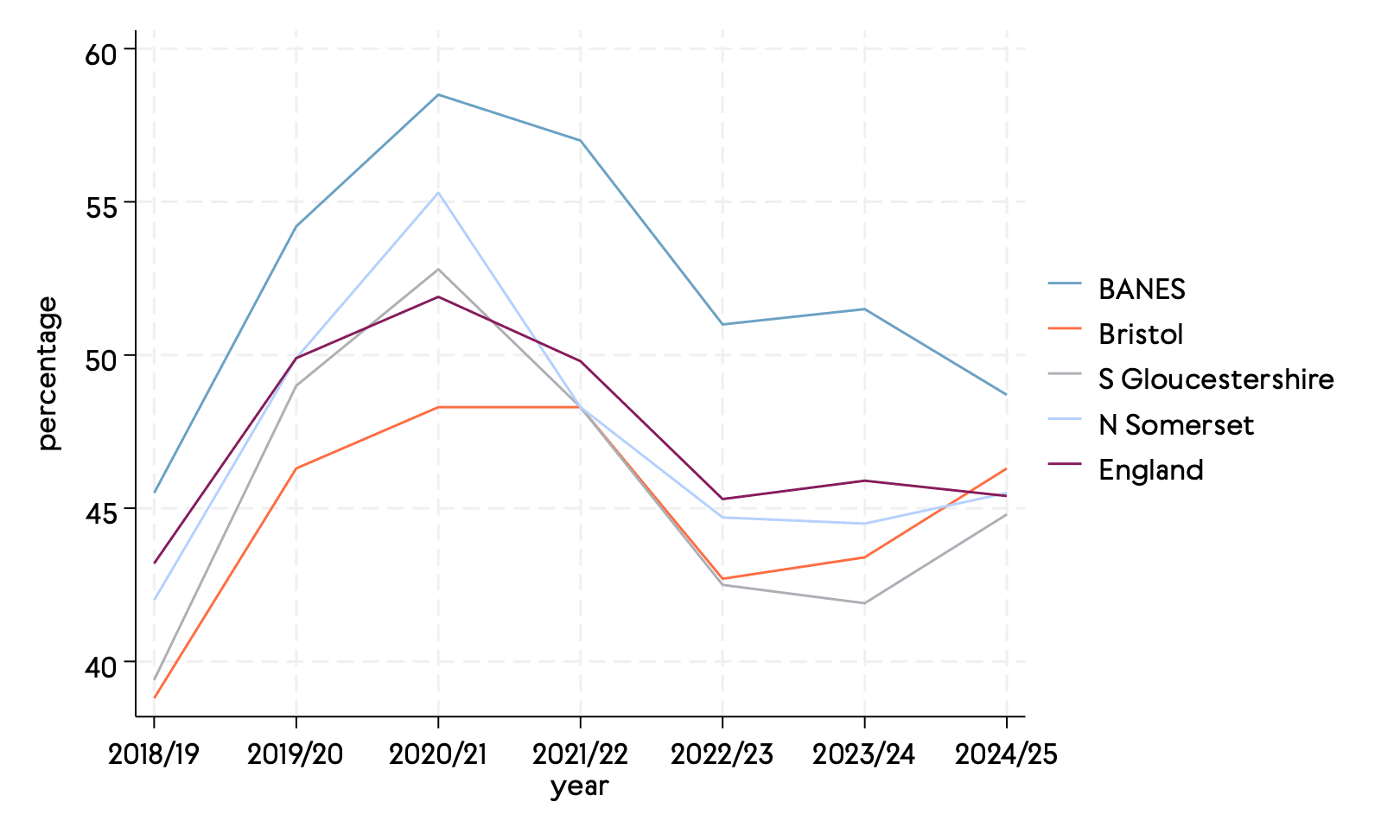
Source: Dept. For Education, Key Stage 4 performance tables. https://explore-education-statistics.service.gov.uk/find-statistics/key-stage-4-performance/2024-25/data-guidance
Amongst free school meal (FSM) eligible young people, attainment at grade 5 or higher in English and maths GCSE is particularly poor in the region, with all four areas below the average for England (25.9%). Indeed, data from the 2025 Sutton Trust Opportunity Index report revealing that two Bristol parliamentary constituencies (Bristol North West and Bristol South) are the lowest ranked in England in terms of the percentage of FSM eligible pupils who attain a degree by age 22 (Sutton Trust, 2025). Only 3.7% of FSM eligible pupils in these constituencies achieve this, compared to 15.9% of FSM eligible pupils across England overall. All areas of the West of England are below this national average (the figure for the Bath constituency is 8.5% for example) which suggests that there are structural inequalities operating to hinder opportunity for disadvantaged students wherever they reside in the region.
Early life health and preventable conditions
Measures of early life health provide important indicators of both current wellbeing and future developmental trajectories. Data show that in the West of England in 2024, the proportion of babies born with a low birth weight was lowest in Bath and North East Somerset (2.06%) and North Somerset (2.10%), both performing better than the England average (2.98%). Bristol (2.77%) and South Gloucestershire (2.70%) were broadly similar to England as a whole, and trends were stable across all areas (Office for Health Improvement and Disparities, OHID, 2025).
Worryingly, inequalities are more pronounced for preventable conditions. Hospital admissions for dental caries (tooth decay or cavities) among children aged 0-5 were substantially higher in Bristol (313.3 per 100,000) than the England average (207.2), while Bath and North East Somerset (229.3), North Somerset (193.3) and South Gloucestershire (206.1) were closer to national levels (OHID, 2025). Dental caries are strongly associated with socio-economic deprivation, diet and access to preventive care, making them a sensitive indicator of inequality.
Respiratory health outcomes show a similar pattern. Hospital admissions for asthma among under-19s were highest in Bristol (185.7 per 100,000), exceeding the England average (148.6), while North Somerset (162.4) showed worsening trends. Bath and North East Somerset performed substantially better than the England average (76.4), indicating better underlying health conditions or access to preventive care (OHID, 2025).
The persistence of preventable health conditions among children in Bristol reflects the link with deprivation, indicating that there are gaps within Bristol in access to prevention, early intervention and supportive services.
Risk behaviours and adolescent vulnerability
Indicators of adolescent risk behaviours provide insight into social vulnerability and future economic risk. Hospital admissions related to substance misuse among young people aged 15-24 were higher than the England average (47.4 per 100,000) across all local authorities, with particularly high rates in Bristol (101.6) and North Somerset (87.3). Bath and North East Somerset (66.8) and South Gloucestershire (65.9) were also elevated relative to England (OHID, 2025).
Teenage conception rates vary by area — some places have consistently higher rates than others. Bath and North East Somerset (6.95 per 1,000) and South Gloucestershire (8.94) have lower teenage conception rates than the England average (13.89), while Bristol (13.12) and North Somerset (12.81) are similar to, although slightly below, national levels (OHID, 2025). These differences across the region reflect variation in education, deprivation and access to preventive services.
Smoking during pregnancy is an indicator of maternal and child health risk. Rates in Bristol, North Somerset and South Gloucestershire (all 5.8%) are similar to, but slightly below, the England average (6.1%), and declining. Bath and North East Somerset reported a higher rate (9.7%), although data quality issues require cautious interpretation (OHID, 2025).
Mental health and emotional wellbeing
Mental health indicators reveal some of the most significant inequalities within the region. Hospital admissions for mental health conditions among under-18s varied substantially between authorities. North Somerset reported an exceptionally high rate (376.1 per 100,000), far exceeding the England average (80.2), while Bristol also recorded elevated admissions (131.3). Bath and North East Somerset (96.0) and South Gloucestershire (81.6) were closer to national levels (OHID, 2025).
Hospital admissions resulting from self-harm among young people aged 10-24 were higher than the England average (266.6 per 100,000) across all local authority areas in the region. Rates were highest in North Somerset (633.0), followed by Bristol (482.8), South Gloucestershire (476.6) and Bath and North East Somerset (434.4) (OHID, 2025). This indicates widespread mental health challenges affecting young people in the region.
The elevated rates of hospital admissions related to substance misuse and self-harm across all four local authorities – with particularly acute levels in North Somerset and Bristol – are cause for concern. These indicators point to significant pressures on adolescent mental health and wellbeing, and suggest that existing support systems may be insufficient to address underlying drivers such as poverty, social isolation and unmet mental health needs.
The exceptionally high and worsening mental health admission rate among under-18s in North Somerset is especially notable and warrants urgent investigation, as it may reflect both increased prevalence of severe distress and potential gaps in community-based prevention and support pathways.
Conclusion
Bristol consistently experiences lower educational attainment and higher preventable physical health conditions than other local authority areas in the West of England. North Somerset has emerged as an area of concern too – specifically around mental health and self-harm hospital admissions.
These clear spatial disparities across the region suggest that economic disadvantage is becoming increasingly concentrated geographically. This reinforces long-term risks to health, education and socio-economic opportunities across generations, and limits inclusive economic growth in the West of England.
References
Department for Education (2025) Explore Education Statistics: Key Stage 4 attainment. London: DfE. Available at: https://explore-education-statistics.service.gov.uk
Office for Health Improvement and Disparities (2025) Public Health Profiles (Fingertips). London: UK Department of Health and Social Care. Available at: https://fingertips.phe.org.uk
Office for National Statistics (2024) Household income and inequality, UK. Newport: ONS. Available at: https://www.ons.gov.uk/peoplepopulationandcommunity/personalandhouseholdfinances/incomeandwealth
Sutton Trust., 2025. The Opportunity Index. [Online]
Available at: https://www.suttontrust.com/our-research/the-opportunity-index/