infrastructure
inequality
economy
Digital infrastructure in the West of England
Mobile and broadband coverage in the West of England is broadly in line with, or better than the UK average. But investment is needed to close geographic and social digital infrastructure gaps, particularly in BANES. Strengthening digital inclusion across the region would help to ensure that everyone can benefit from future economic growth.
This policy insight provides an overview of the availability and adoption of digital infrastructure in the West of England region, spanning Bath and North East Somerset, Bristol, North Somerset and South Gloucestershire. Comparisons are made with the UK as a whole and the wider South West region encompassing the counties of Cornwall, Devon, Dorset, Somerset, Wiltshire, Gloucestershire, and Bristol. This includes both fixed and mobile broadband coverage, and digital uptake showing the extent to which digital technologies and internet services are being used.
Data on the deployment and adoption of digital infrastructure in the West of England point to three priority actions to improve the region’s digital infrastructure gaps. Wireless connectivity should be built into the planning and delivery of all new physical infrastructure to ensure timely and fair access across the region. Persistent underperformance in Bath and North East Somerset (BANES) needs to be addressed so that it can keep pace with neighbouring areas. And a centralised approach to digital inclusion is required to reduce fragmentation among the nearly 200 existing providers and create a more coherent, effective support system.
What does the evidence tell us?
Digital infrastructure in the West of England, including ‘superfast’ fixed broadband and 4G mobile coverage, performs broadly in line (+/-0.5%) with UK averages. While much of the region is adopting updated gigabit and 5G services, delivery in BANES is progressing more slowly than both neighbouring areas and the national benchmark.
The adoption of state-of-the-art technologies and speed of services can affect firm productivity, business numbers and local employment. Faster broadband offers pronounced benefits, particularly for service industries and skilled workers in urban areas, while offering fewer gains for low-skilled workers and rural firms (What Works Centre for Local Economic Growth, 2015).
The West of England’s local authorities also perform largely in line with the national average for digital inclusion and participation, but within each area there are significant pockets of digital exclusion. This limits access to employment and services, often reproducing the difficulties faced by vulnerable and disadvantaged communities in a vicious circle. In the wider economy, adoption is an important multiplier alongside deployment: a 1% increase in digital adoption is estimated to increase GDP per capita by between 0.026% and 0.033% for fixed broadband and 0.084-0.113% for mobile (Briglauer et al., 2025).
The national wireless landscape
Past national schemes, such as the Superfast Broadband Programme and Shared Rural Network, that aimed to deliver ‘superfast’ broadband and 4G coverage respectively to over 95% of the UK, have been highly effective. But, at present, there is no central government funding for mobile 5G infrastructure – coverage ambitions are expected to be met through commercial investment.
Nevertheless, there are existing government projects for state-of-the-art broadband infrastructure, including the £5 billion Project Gigabit. This initiative sets out to provide gigabit-capable broadband (1 gigabit per second, gbps, speeds) to 99% of homes and businesses not covered by commercial plans nationally by 2032.
It has been reported that by July 2025, gigabit-capable coverage was 85.9% and take-up was also on an upward trend, increasing 7% year-on-year. Yet, concerns have been raised by network operators suggesting that many UK residents will not get access to this coverage (Department for Science, Innovation and Technology, 2023). The figures in this and the next section should therefore be interpreted with the caveat that coverage is limited until on-the-ground signal testing and/or crowdsourced data are available.
Connectivity in the West of England
Accelerating digital transformation is a stated priority for the West of England Combined Authority (WECA). The West of England Digital Office is a new pilot project providing tailored support to enable the accelerated rollout of fast and reliable digital connectivity infrastructure. This typically involves attempts to reduce planning barriers, streamline processes and share data and expertise.
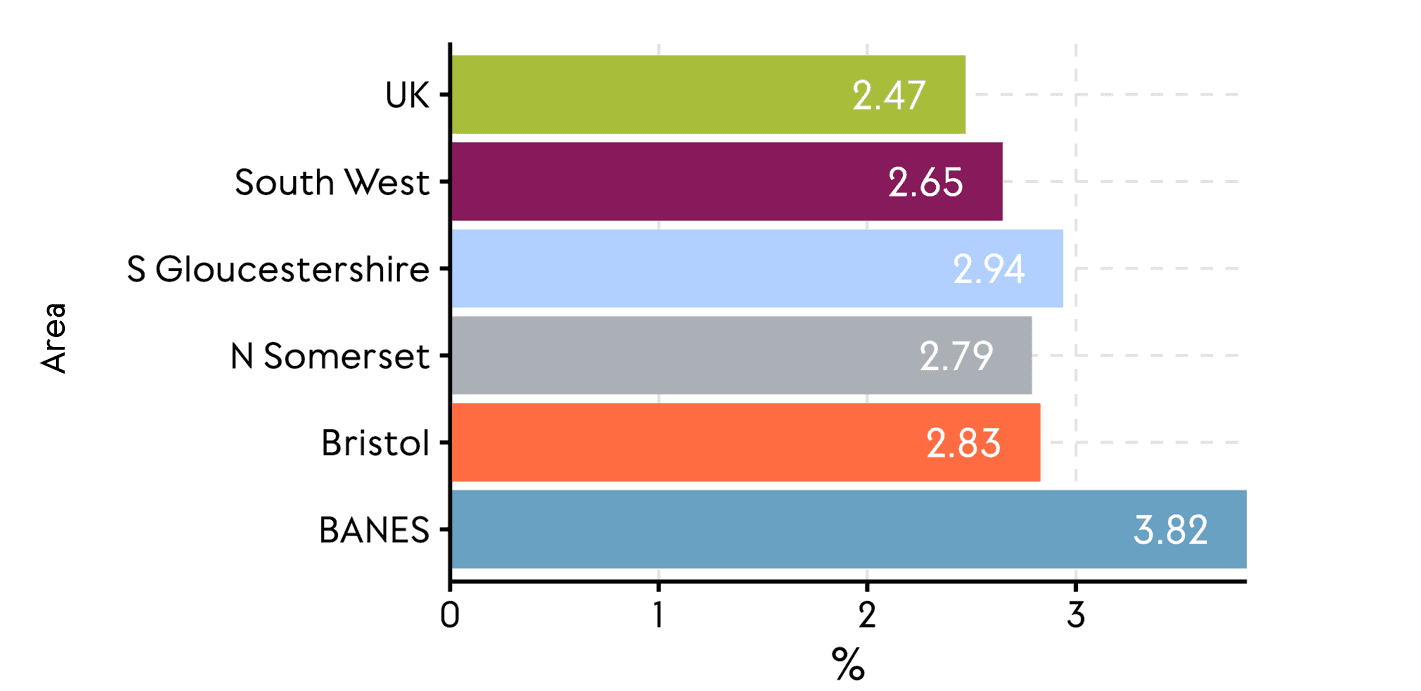
The current digital infrastructure picture for the region is mixed. There is evident success in the rollout of broadband across the region, but there are still areas where further deployment is needed to avoid falling behind. Just over 3% of premises in the West of England are without known ‘superfast’ broadband availability, which is 0.5 percentage points higher than the national average, and also higher than the average in the wider South West region (see Figure 1).
Figure 1: Lack of access to superfast broadband across WECA local authorities, 2025
Source: Ofcom Connected Nations, 2025
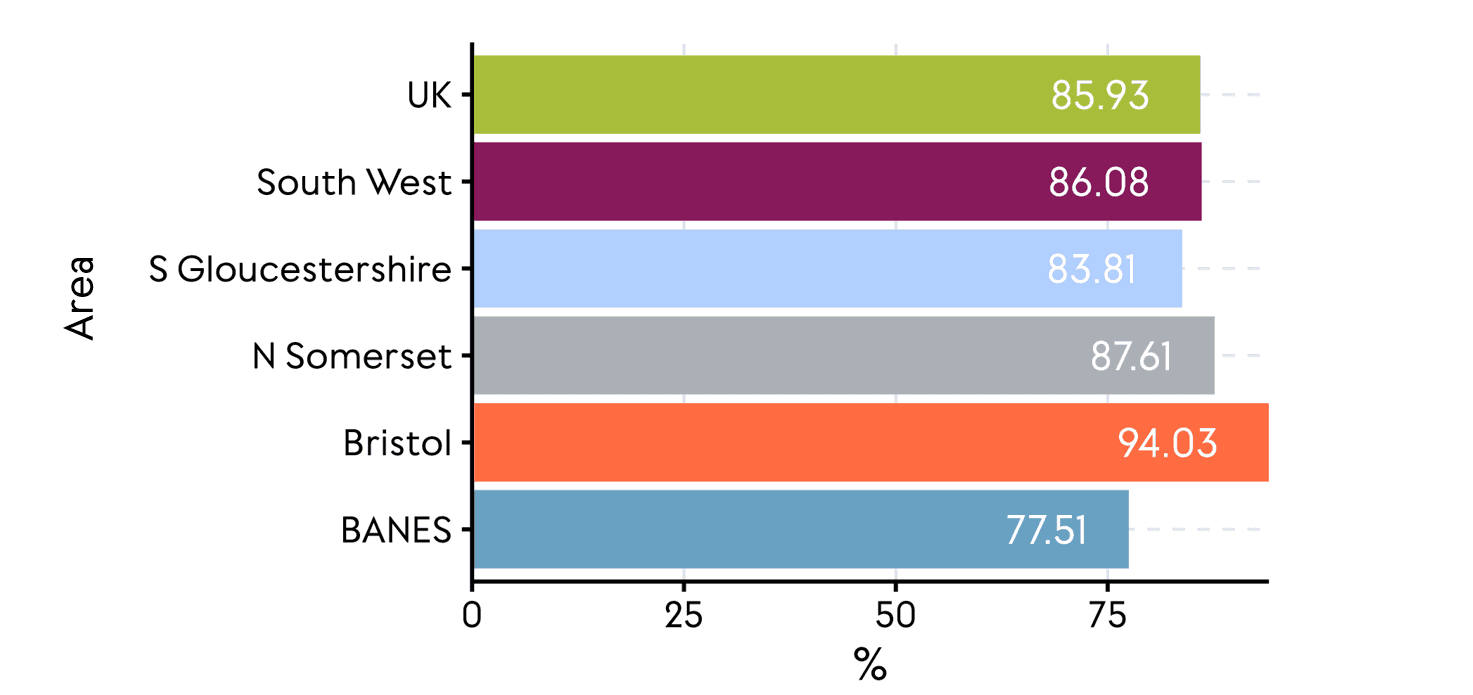
Coverage of gigabit-capable fixed broadband, on the other hand, is greater in the West of England (at 87.6% of premises) than the UK average (see Figure 2). But this hides considerable variation across the region, again with BANES falling short, while Bristol drives the regional average up through particularly high coverage.
Figure 2: Gigabit broadband availability across WECA local authorities, 2025
Source: Ofcom Connected Nations, 2025
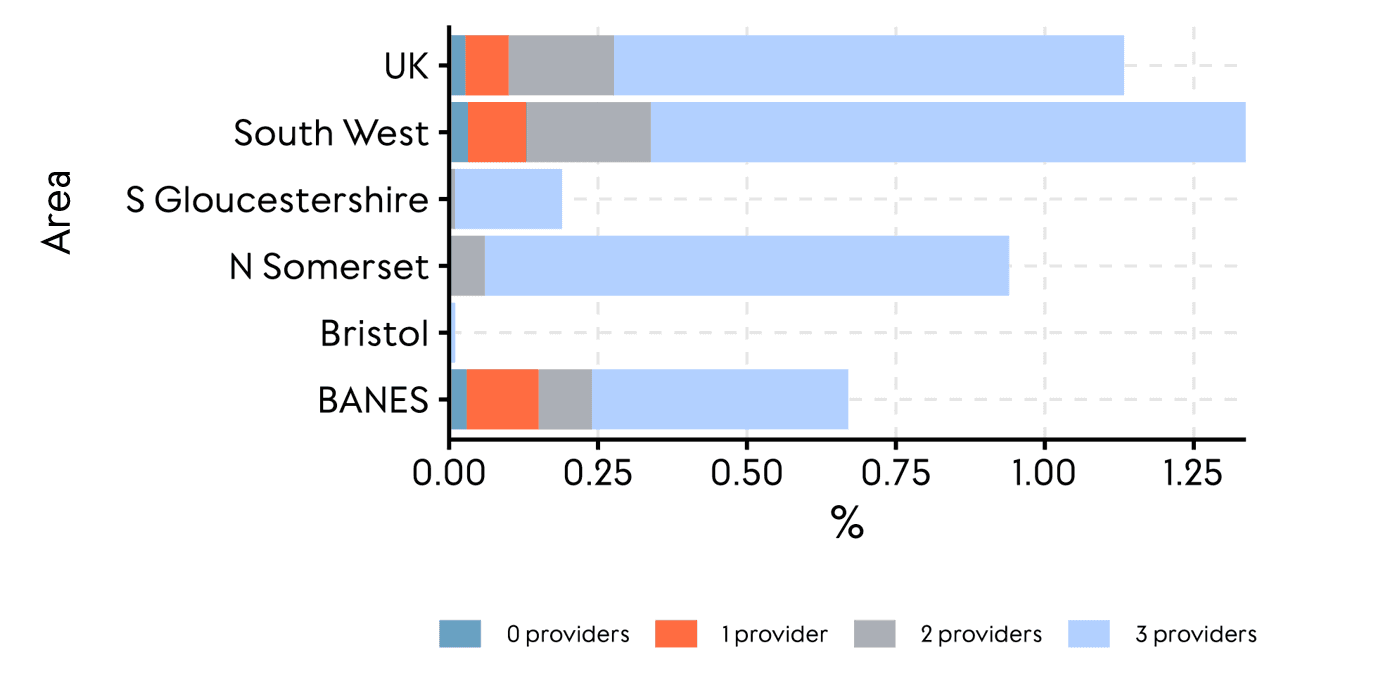
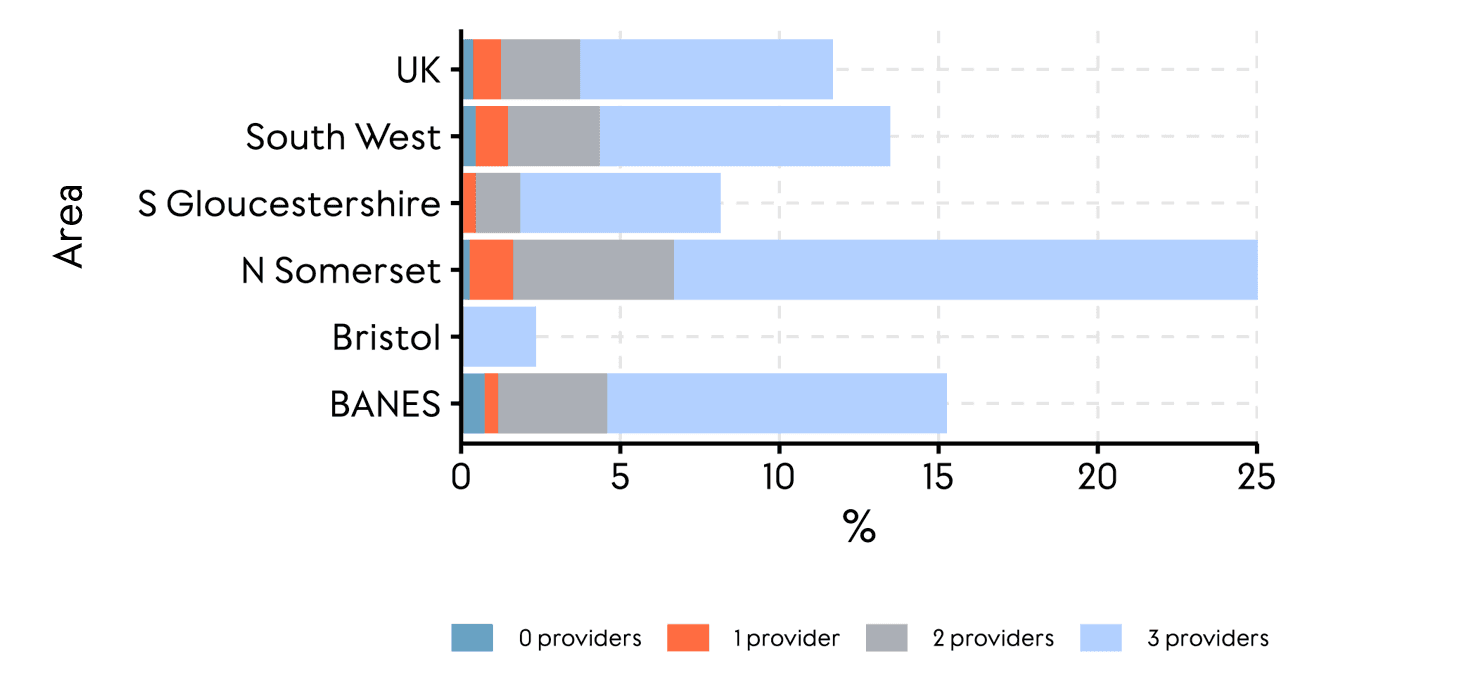
For mobile broadband, the region compares relatively well to the rest of the country. There are already a very small number of premises that do not have 4G outside coverage from all four UK-wide operators (just over 1%), but the proportion is even lower in the West of England’s local authorities (see Figure 3).
4G coverage is consistently higher outside premises than inside, reflecting signal attenuation through building materials, as shown in Figure 3. And coverage also improves as the number of network providers available at a location increases, reducing the likelihood of ‘not spots’.
Figure 3: 4G coverage outside (first chart) and inside (second chart) premises by number of network providers
Source: Ofcom Connected Nations, 2025
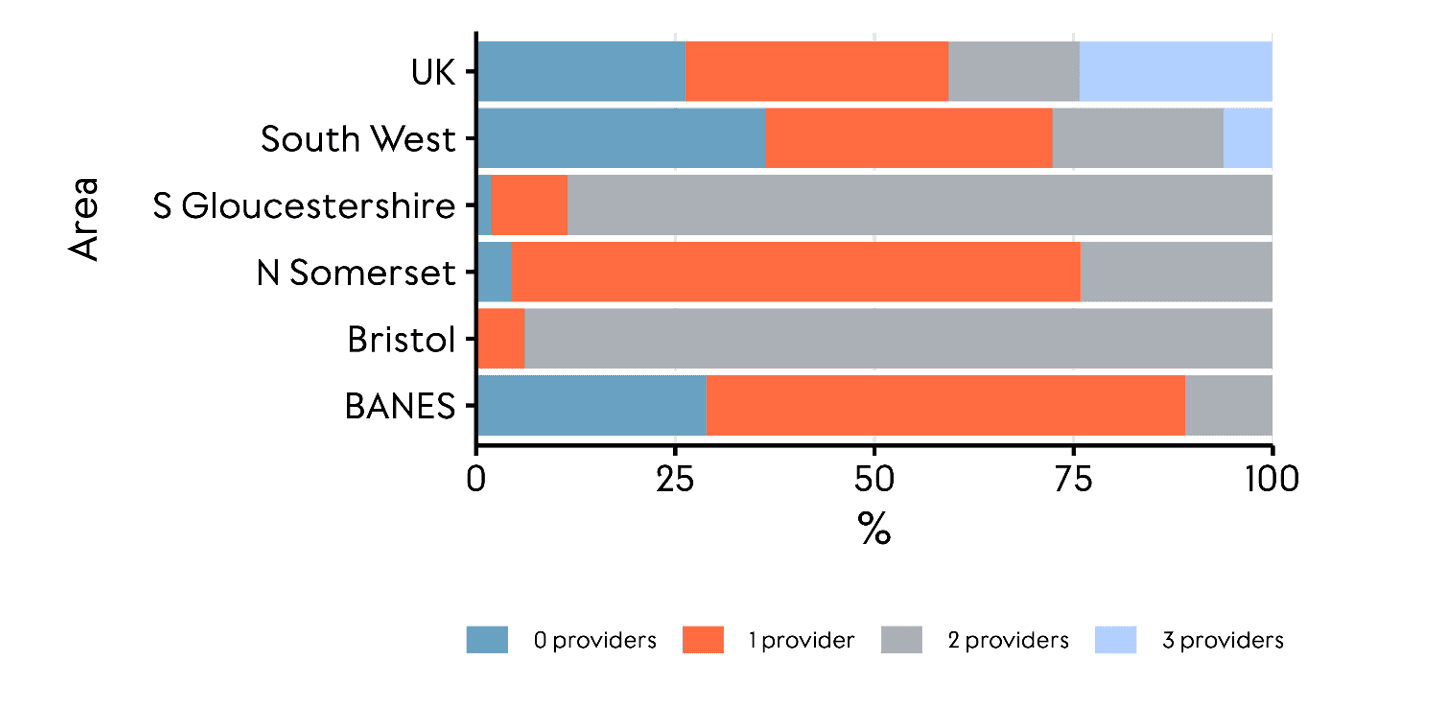
The are disparities in 5G availability outside premises across the West of England, as shown in Table 1 and Figure 4. Bristol (0.03%) and South Gloucestershire (1.96%) have very few premises without any 5G provider, while the share in North Somerset (4.34%) is higher. BANES is far behind the other areas, as 28.88% of premises do not currently have 5G coverage, above the UK average of 26.23% and close to the South West regional figure of 36.40%. Note that Ofcom do not provide data on 5G connectivity inside premises.
Although outdoor connectivity and competition among providers help to lift performance, indoor coverage and 5G availability remain uneven (as indicated in Figure 4 and Table 1). This underscores the need for targeted actions, such as planning for in-building solutions and accelerating 5G rollout, that would ensure that households and businesses across the West of England can benefit equally from digital infrastructure.
Table 1: Percent of premises without 5G coverage from any network provider
Bath and North East Somerset | 28.88% |
Bristol, City of | 0.03% |
North Somerset | 4.34% |
South Gloucestershire | 1.96% |
UK | 26.23% |
South West | 36.40% |
Figure 4: 5G coverage outside premises by number of network providers
Source: Ofcom Connected Nations, 2025
Delivery of state-of-the-art technological infrastructure in BANES is often behind other West of England local authorities. Although this gap has narrowed over time, BANES maintains a marginal disadvantage for previous-generation technologies such as superfast broadband and 4G connectivity.
This disparity is indicative of the area’s consistently weak productivity when measured against the other local authorities, because the economic benefits of new technologies are often afforded to ‘first movers’. Fewer firms in BANES can fill this role if access is slow, and as wider innovative technology adoption often relies on strong digital infrastructure, such as mobile and fixed broadband (Jibril and Roper, 2025).
Digital inclusion and adoption in the West of England
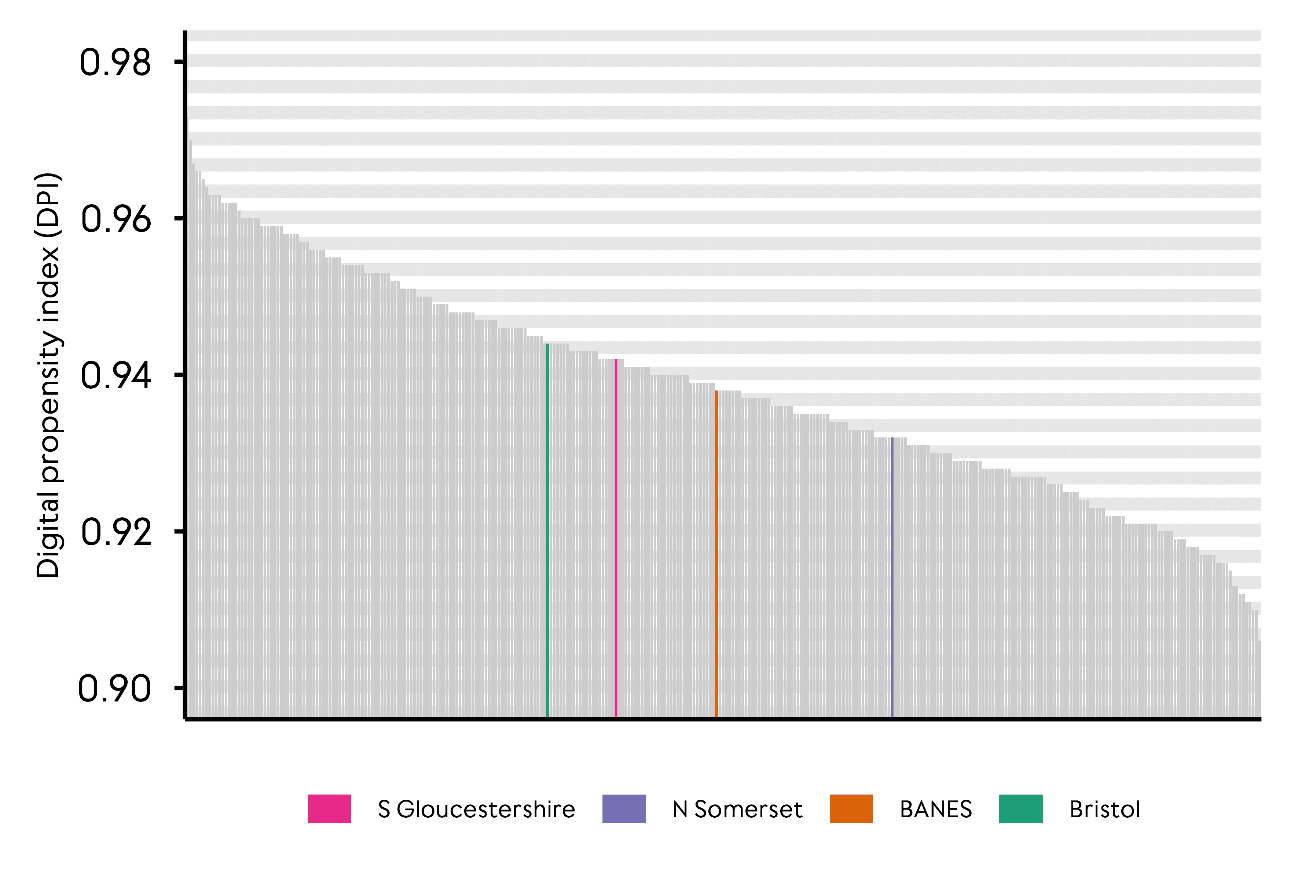
The Office for National Statistics (ONS’s) Digital Propensity Index (DPI) users’ online take up for the 2021 census as a proxy to measure digital deprivation, with higher scores indicating greater take up of technology. Aggregated to the local authority level, the DPI ranges roughly from 0.98 at the top to just above 0.90 at the bottom (see Figure 5).
Within the West of England, Bristol has the highest DPI among the four local authorities, although it is not in the top 25% of the UK. South Gloucestershire and BANES fall close to each other in the mid-range, slightly below Bristol. North Somerset is the lowest, though still above the national average. The overall spread within the West of England is relatively narrow, with all four authorities scoring above 0.92, suggesting generally good digital engagement compared with the lowest scoring areas nationally.
Figure 5: Digital Propensity Index – the distribution of all local authorities, 2021
Source: ONS Census, 2021
At the finer scale, the ONS data include ‘lower layer super output areas’ (LSOAs) – defined as geographies that typically consist of between 400 and 1,200 houses. Across the West of England, 18 LSOAs have an index below 0.90, but none below 0.86. This suggests that while pockets of digital exclusion exist, they are not extreme. Still, despite the West of England’s reputation as a hub of tech prosperity, these figures indicate that many communities within the region experience digital deprivation. Over 14% of adults – around 100,000 people – are either non-users or very limited users of the internet, and between 39% and 41% of households with children fall below the minimum digital living standard, defined as having ‘accessible internet, adequate equipment, and the skills and knowledge’ needed (Good Things Foundation, 2024).
Vulnerable groups, such as older adults, low-income households, carers, refugees and people with disabilities, are disproportionately affected by digital exclusion. Barriers include the affordability of devices and connectivity, limited awareness of social tariffs, poor design of online services, and transport challenges for accessing support.
These pockets of digital exclusion create significant disparities in digital skills across the region, which have knock-on effects on education, employment and access to services and support. As services move online, those who are digitally excluded face disadvantages: existing inequalities reduce digital access, and limited digital access deepens those same inequalities. This reinforcing cycle, in which economic, social and digital deprivation intersect, makes it harder for affected individuals and communities to improve their circumstances without coordinated, cross-cutting interventions.
Conclusion
The West of England has spatial and social inconsistencies around digital access and the pace of technological change across local authorities. In particular, delivery of infrastructure in BANES is frequently behind other areas. With progress remaining uneven, a more balanced and coordinated delivery of digital infrastructure projects is needed in the region.
By drawing on national programmes, private investment and stronger data tools to identify gaps, a more coherent approach to digital inclusion could be achieved. Using interactive maps and data dashboards to monitor coverage gaps, and commissioning research to establish how broadband affects regional outcomes, could help to identify effective interventions that ensure that investment delivers maximum impact.
Efforts should also be made to reduce fragmentation among the nearly 200 providers in the West of England, with the aim of building a sustainable regional network that guarantees all residents and businesses can benefit from digital transformation. There is scope to align digital planning with energy infrastructure, such as electric vehicle (EV) charging networks and smart grids. This would support the transition to low-carbon mobility; an approach that is technically feasible and increasingly adopted in smart city strategies.
Looking ahead, the West of England’s authorities could also establish a regional digital inclusion network, to raise awareness of national resources and improve signposting to local support.
References
Briglauer, W., & Grajek, M. (2024). Effectiveness and efficiency of state aid for new broadband networks: Evidence from OECD member states. Economics of Innovation and New Technology, 33(5), 672-700. Available at: https://www.tandfonline.com/doi/full/10.1080/10438599.2023.2222265#d1e167
Briglauer, W., Cambini, C., Gugler, K., & Sabatino, L. (2025). Economic benefits of new broadband network coverage and service adoption: evidence from OECD member states. Industrial and Corporate Change. Available at: https://academic.oup.com/icc/article/34/4/696/7965758
Department for Science, Innovation and Technology (2023). UK Wireless Infrastructure Strategy. GOV.UK. April. Available at: https://www.gov.uk/government/publications/uk-wireless-infrastructure-strategy/uk-wireless-infrastructure-strategy
Jibril, H. & Roper, S. (2025) Factors influencing firms’ adoption of advanced technologies: A rapid evidence review. DSIT and DCMS. GOV.UK. August. Available at: https://www.gov.uk/government/publications/barriers-and-enablers-to-advanced-technology-adoption-for-uk-businesses/factors-influencing-firms-adoption-of-advanced-technologies-a-rapid-evidence-review
Ofcom (2025) Connected Nations: UK Report 2025. November. Available at:
Good Things Foundation (2024). Understanding digital exclusion in the West of England: A report to inform the West of England Mayoral Combined Authority’s digital inclusion programme. West of England Combined Authority. December. Available at: https://www.westofengland-ca.gov.uk/wp-content/uploads/2025/03/Understanding-Digital-Inclusion-Tagged.pdf
What Works Centre for Local Economic Growth (2015). Evidence Review 6: Broadband. March: ESRC. Available at: 15-03-10-Broadband-Full-Review.pdf