population
infrastructure
employment
Mobility and internal migration in the West of England
Internal mobility is reshaping the West of England. Relocation patterns indicate that people are moving out of city centres and into surrounding areas. As jobs remain concentrated in cities, housing affordability and transport connectivity are essential to sustain the region’s productivity and retain skilled workers.
This policy insight examines internal migration in the West of England from 2012 to 2024, using data from the Office for National Statistics (ONS).
Between 2012 and 2024, Bristol experienced a shift in internal migration trends, moving from a net importer of residents to a net exporter, as more people left the city than arrived. Over the same period, South Gloucestershire and North Somerset increasingly attracted people moving into the area. This trend began before the COVID-19 pandemic but has since intensified with the expansion of hybrid working.
This trend suggests that workers and skills are spreading more widely across the West of England. As people move further from the main employment centres, which remain concentrated in cities, housing affordability and good transport links become more important. These factors help to boost productivity and retain skilled workers, ensuring that people can still access jobs across the region.
Mobility and internal migration in context
Attracting and retaining talent is an increasing challenge for the UK. While policy attention often focuses on international migration, internal mobility also plays a crucial role in shaping the labour market characteristics of a region.
High housing costs in major urban areas are associated with people moving out of cities ('outward residential mobility') and into surrounding towns and villages, while employment often remains concentrated in cities (Dickey and Magante, 2025). Since 2020, the rise in hybrid working has further altered residential incentives by reducing commuting frequency and increasing flexibility in workplace location (Barrero, et al., 2021). Domestic migration patterns therefore reflect housing affordability, employment opportunities and local services, as well as more recent trends in remote and hybrid work.
In the West of England, increasingly dynamic patterns of internal migration raise important considerations for labour market and skills policy. If residential patterns are shifting outward while high-value employment remains concentrated in urban centres, the effective matching of workers to jobs becomes more dependent on connectivity, housing availability and commuting flexibility.
As such, internal mobility influences not only where people live, but how skills are allocated across the West of England economy, while also having significant implications for regional infrastructure. Outward residential movement among working-age and highly-educated households may affect local labour supply, commuting intensity and the distribution of human capital (a measure of education and skills) across local authorities.
This policy insight takes a first step in examining internal mobility trends that may have important consequences for the West of England’s economic trajectory. Understanding how population changes interact with labour demand, skills concentration and sectoral development will be critical for productivity gains, retaining talent and boosting sustainable economic growth.
Internal migration in the West of England
Internal migration across the West of England has generally been characterised by stronger inflows than outflows, meaning more people have moved in than moved out. The region has therefore, historically, been a 'net receiver of population'. But this net inflow has weakened since the mid-2010s, with a noticeable contraction around the time of the COVID-19 pandemic with trends across local authorities differing thereafter.
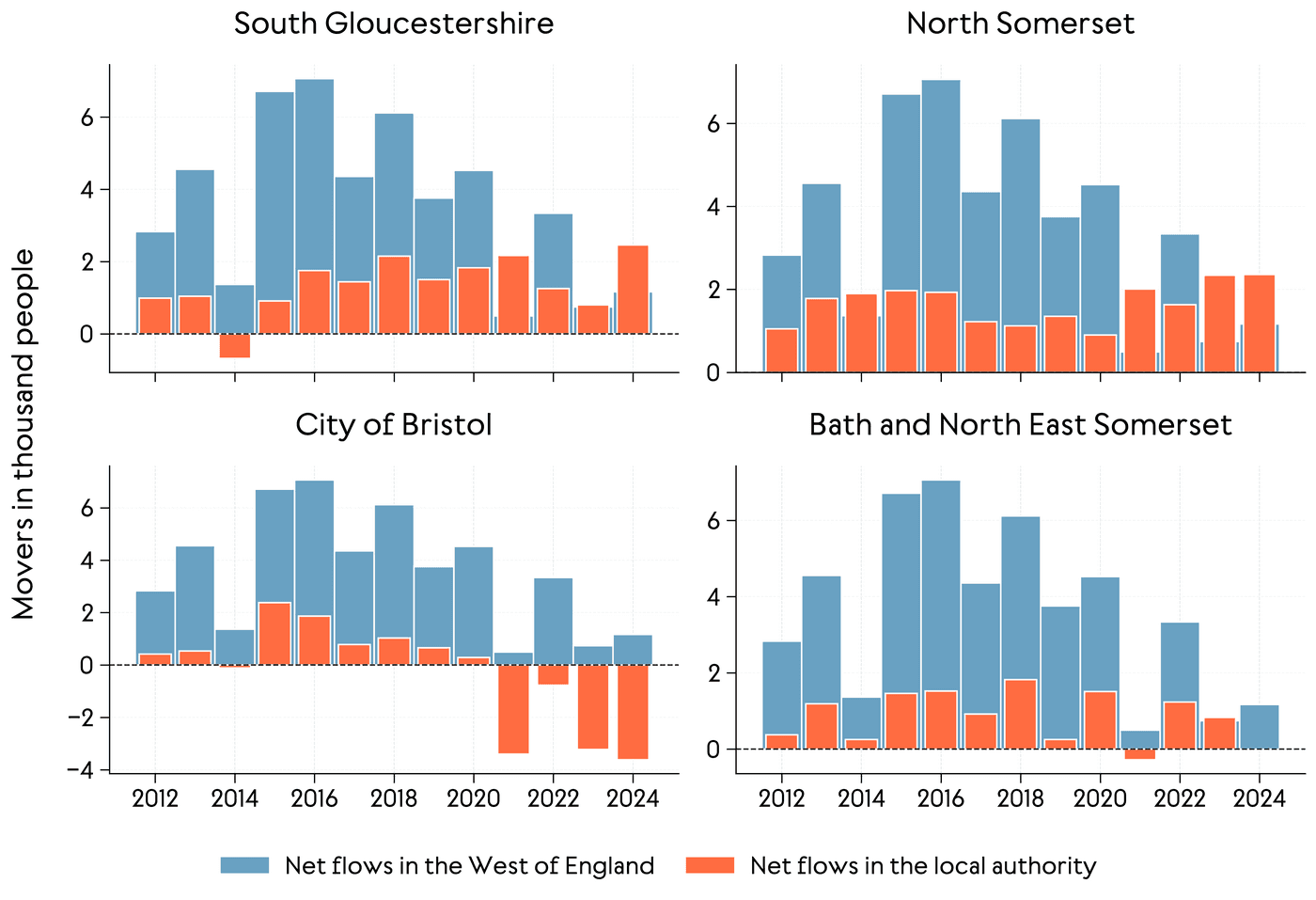
Net inflows to the West of England peaked in 2016 at approximately 7,000 people. During this period, population gains were relatively evenly distributed across local authorities, although Bristol and North Somerset saw greater numbers of people moving in the early years. From 2017 onwards, net inflows began to slow before altering significantly during the pandemic (2020-21). Consistent with the broader collapse in mobility during the pandemic, net inflows in the West of England fell sharply in 2020 and 2021. In the following years, these figures have remained low or fallen in some local authorities (see Figure 1, which shows net internal migration for the region alongside net flows in each local authority, 2012-24).
Figure 1: Net internal migration in the West of England by local authorities, 2012-24
Source: Internal migration in England and Wales; moves by local authorities, years ending June 2012 to June 2024.
Note: Internal migration is defined as residential moves between different local authorities in the UK, including those that cross the boundaries between the four UK countries. Here, only moves affecting local authorities in England and Wales are included. The statistics exclude any moves within a single local authority and any international moves either into or out of the UK.
Bristol and, to a lesser extent, Bath and North East Somerset have become net exporters of people, with more people moving out than moving in. In contrast, South Gloucestershire and North Somerset have displayed comparatively steadier and more persistent positive net inflows. This pattern suggests that the overall weakening of the regional net balance has been driven primarily by shifts in the largest urban centres rather than by a decline across all local authorities. This is broadly consistent with city centre trends.
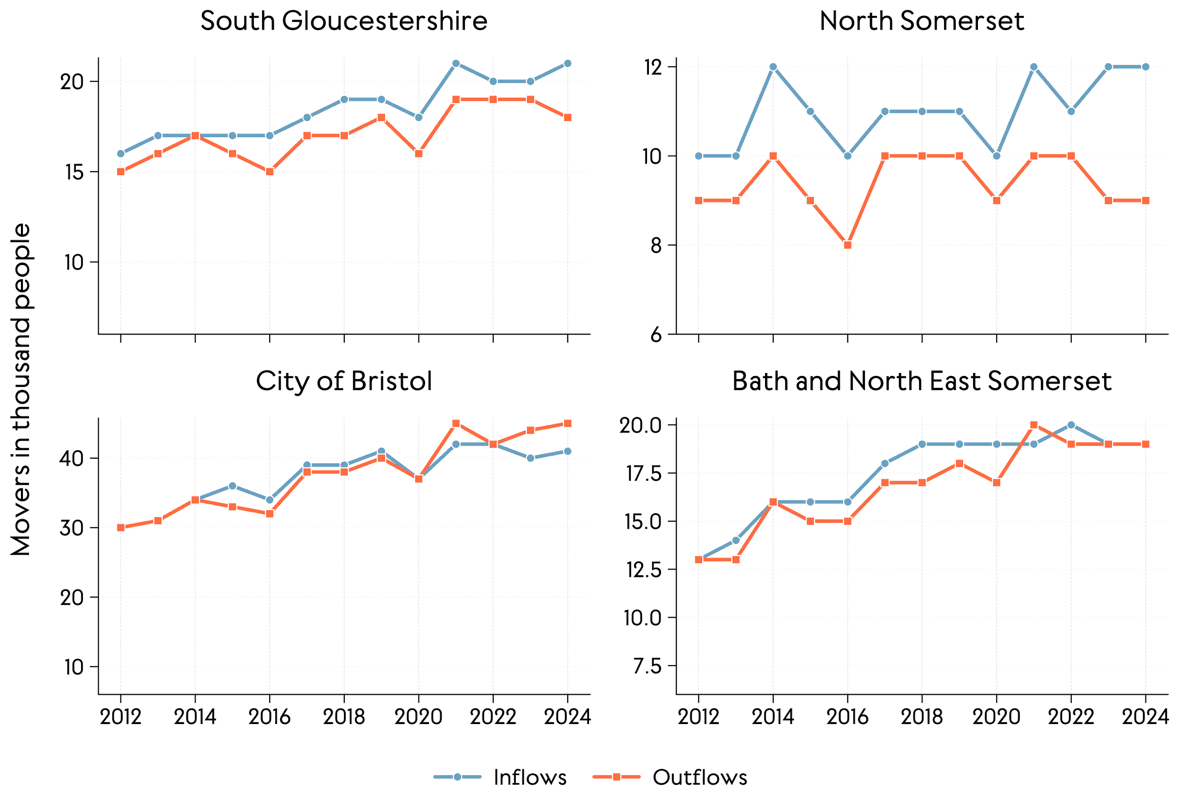
While Figure 1 highlights net balances, Figure 2 examines gross inflows and outflows. This distinction is important as changes in net migration may reflect shifts in either inflows, outflows or both. Bristol stands out as the most dynamic local authority, recording the highest volumes of both movers in and movers out throughout the period. In 2012, over 30,000 people moved into the city and a similar number left, resulting in a net balance close to zero. Flows expanded substantially in the second half of the 2010s, reaching around 40,000 people by 2024.
Figure 2: Internal migration in the West of England by local authorities, 2012-24
Source: Internal migration in England and Wales; moves by local authorities, years ending June 2012 to June 2024.
Note: Internal migration is defined as residential moves between different local authorities in the UK, including those that cross the boundaries between the four UK countries, only moves affecting local authorities in England and Wales are included here. The statistics exclude any moves within a single local authority and any international moves either into or out of the UK.
While a rising number of people have moved in to Bath and North East Somerset over the period, increasing from around 13,000 in 2012 to approximately 19,000 in 2024, net flows have trended downward since 2018 and turned negative in some post-pandemic years. Several factors may have contributed to this decline, including housing affordability pressures and more flexible commuting patterns associated with hybrid working.
Internal migration patterns in South Gloucestershire have been more consistent. The number of people moving in has risen over time, but net the inflow has remained comparatively steady. South Gloucestershire is a hub for advanced manufacturing, aerospace, defence and technology-related activities, as well as having significant employment in logistics and distribution. These sectors tend to generate sustained demand for specialised technical and professional skills, as well as for mid-skilled roles linked to supply chains. These industries, as well as those in nearby Bristol, likely contribute to the area's stable net migration inflows, as they help to attract and retain working-age households, particularly those seeking proximity to employment centres and more suburban affordable housing options.
North Somerset has experienced a relatively steady flow of people moving in and out, with a widening gap since the pandemic. This relative stability may reflect differences in the local economy and housing affordability, such that the recent rise may be driven by residential preferences as well as rapid employment expansion. The area may also be attracting households seeking lower density areas that are still in reach of job opportunities in Bristol. This dynamic has likely intensified since the pandemic as remote and hybrid working arrangements have increased the feasibility of commuting over longer distances on a less frequent basis.
Further analysis of the age and skill composition of movers is required to assess whether these changes reflect a temporary rebalancing or a long-term structural shift.
Mobility within the West of England
By narrowing the focus to examine movements exclusively within local authorities in the West of England, we can better understand patterns of movement.
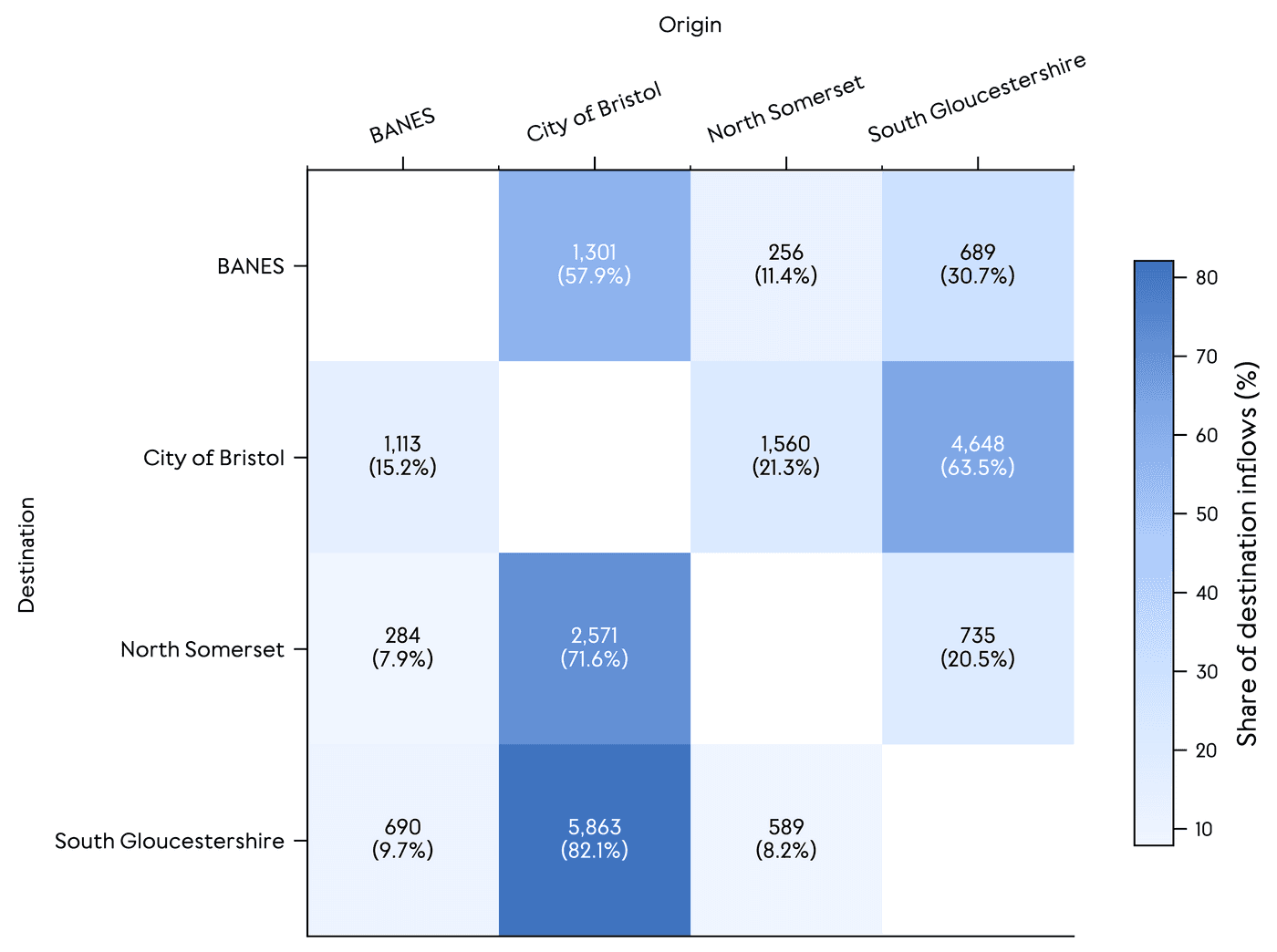
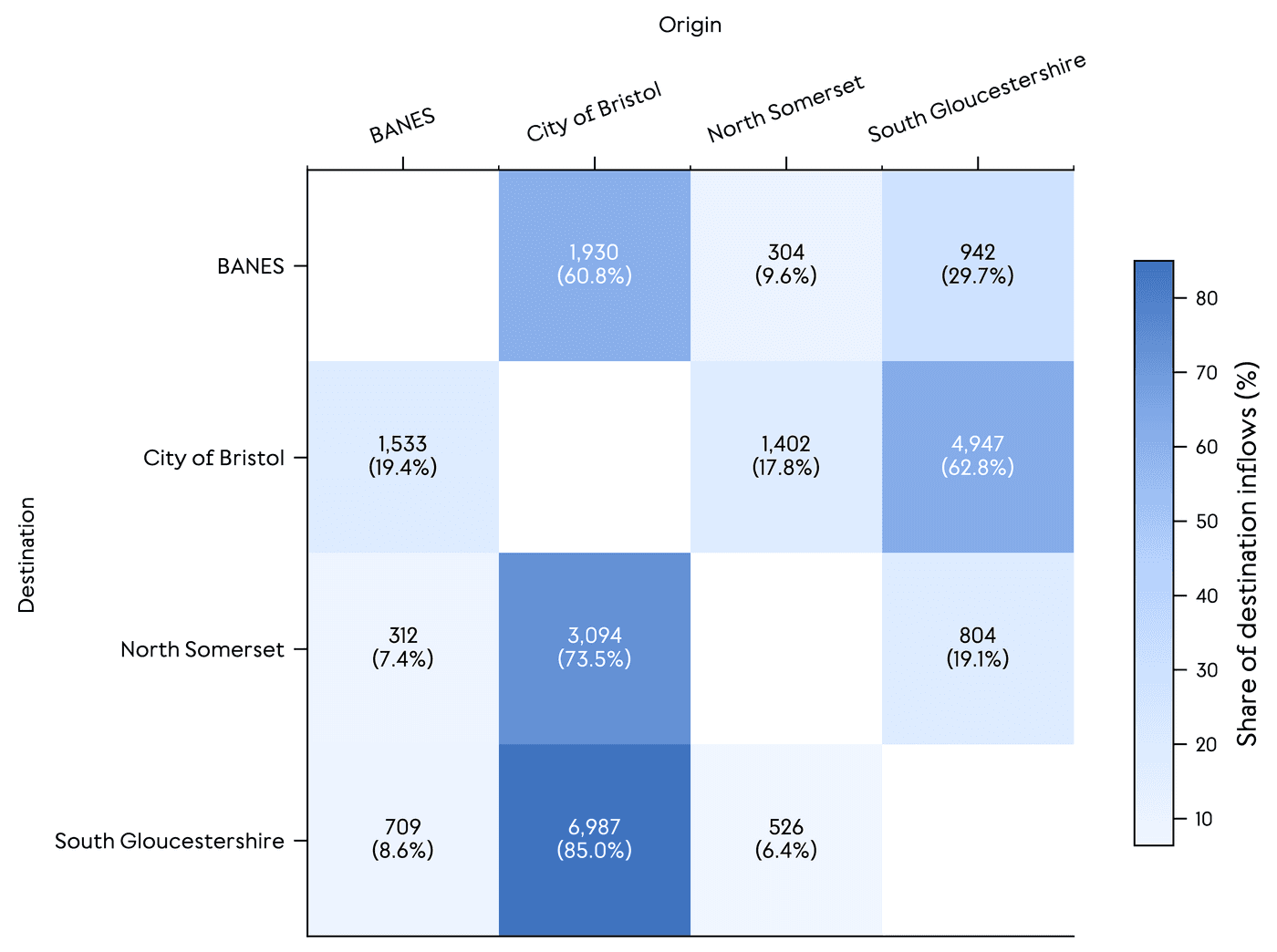
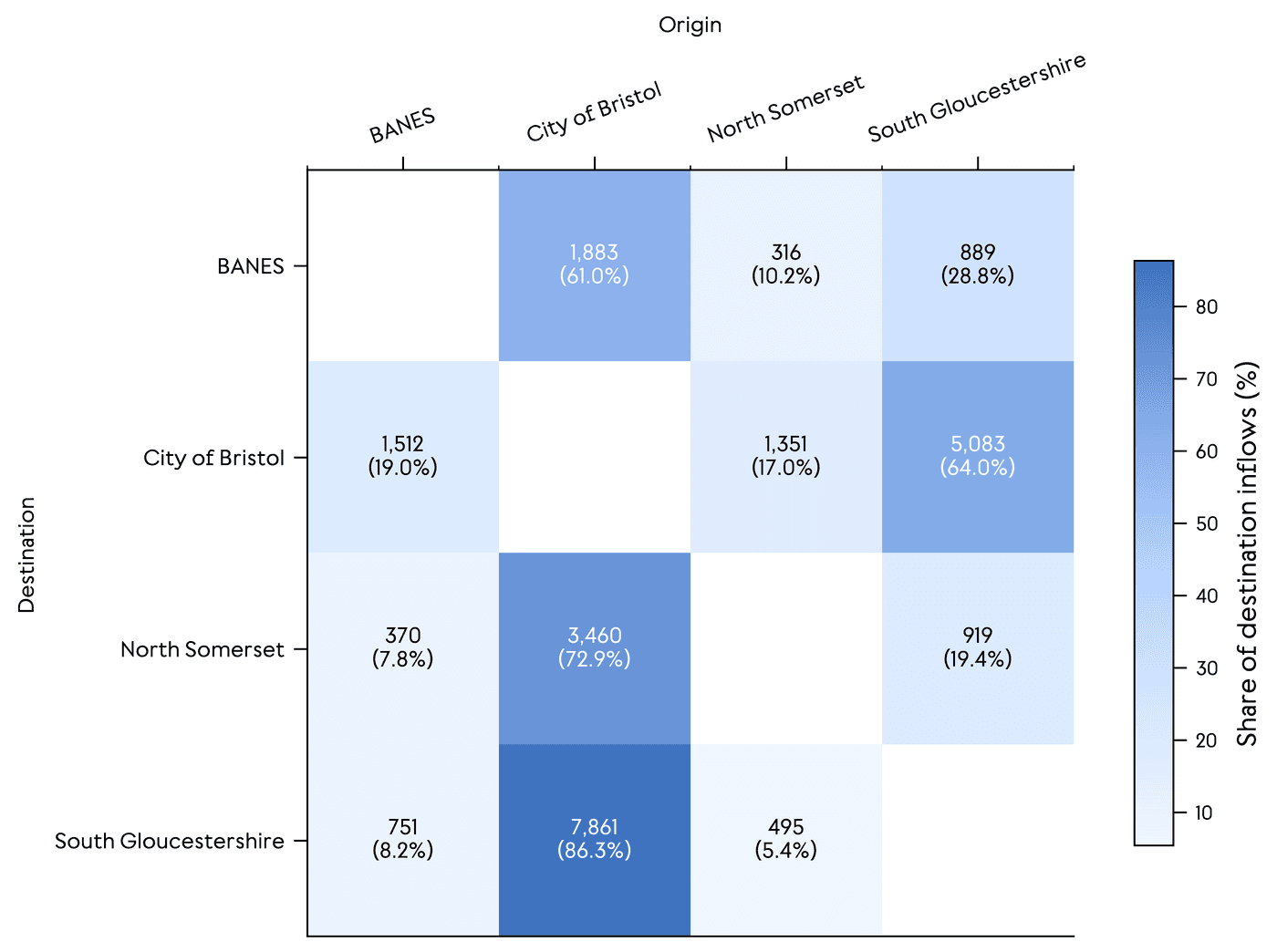
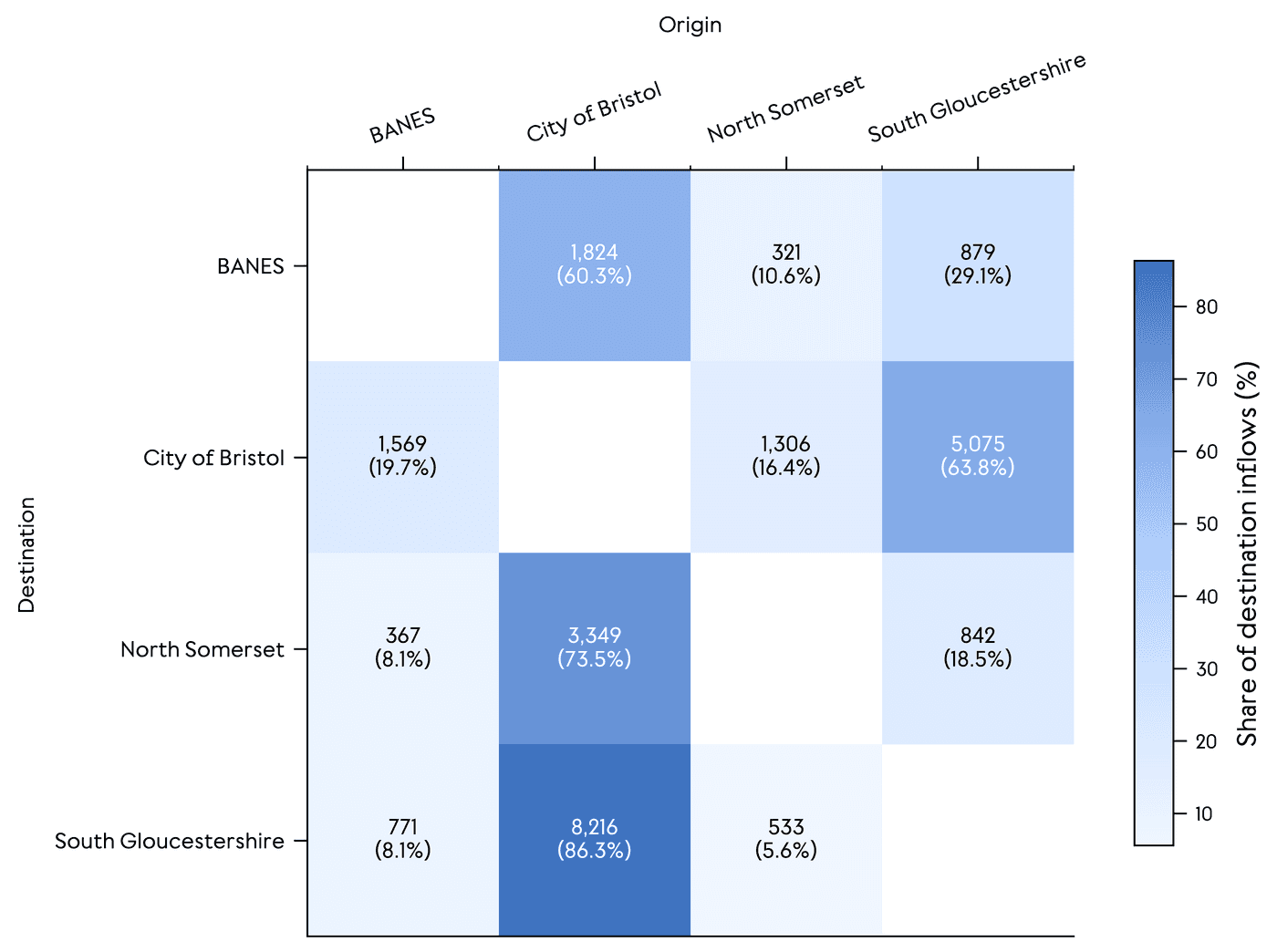
In Figure 3, columns report the origin of movers, while rows show their destination. Each cell therefore records bilateral flows within the region, i.e. the number of people moving from one local authority to another.
For example, in 2012, 1,301 people moved from Bristol to Bath and North East Somerset, while 1,113 moved in the opposite direction. This resulted in a net outflow of 188 people from Bristol to Bath and North East Somerset that year.
Figure 3: Square matrix of inflows and outflows; origin to destination across the local authorities in the West of England, 2012
Source: Table IM2012-T2: 2012 local authority boundaries, ONS.
Figure 4: Square matrix of inflows and outflows: origin to destination across the local authorities in the West of England, 2019
Source: Table IM2019-T2: 2019 local authority boundaries, ONS.
Movements between Bristol and South Gloucestershire are substantial, with a net outflow of 1,011 people from Bristol in 2012. A similar pattern is observed between Bristol and North Somerset, where the net outflow from Bristol reached 1,215 people. These figures indicate that even as early as 2012, the most substantial relocation of people in the region was from the city out to surrounding areas.
This pattern still applied in 2019. Before the pandemic, flows between Bristol and both South Gloucestershire and North Somerset were already the largest within the region, which suggests that a broader structural pattern in residential relocation exists in the region and it is not solely the pandemic that has driven these trends.
These dynamics have intensified in recent years (see Figures 5 and 6). Mobility across local authorities in the West of England has increased as hybrid working and greater flexibility in commuting have expanded. Outflows from Bristol to South Gloucestershire and North Somerset grew faster than inflows in the opposite direction in 2023 and 2024, reinforcing Bristol’s position as a net exporter of population within the region.
The scale of change is particularly marked for South Gloucestershire, which now has a net inflow from Bristol roughly three times higher than it did in 2012. North Somerset has also seen a substantial rise, with net inflows from Bristol approximately doubling relative to 2012 levels. By contrast, exchanges between Bristol and Bath and North East Somerset have increased more moderately.
Figure 5: Square matrix of inflows and outflows: origin to destination across the local authorities in the West of England, 2023
Source: Table IM2023-T2: 2023 local authority boundaries, ONS.
Figure 6: Square matrix of inflows and outflows: origin to destination across the local authorities in the West of England, 2024
Source: Table IM2024-T2: 2024 local authority boundaries, ONS.
Conclusion
While the West of England has remained an attractive place to live, a substantial number of people have recently relocated out of the region’s cities. Bristol has transitioned from being a net receiver to becoming a net exporter of population since 2021. South Gloucestershire and North Somerset have absorbed an increasing share of residents. This pattern appears to predate the COVID-19 pandemic, but it has intensified since 2020, likely as a result of the rise in hybrid working. Households have been able to relocate while still retaining some connection to city centre employment opportunities. As a result, where people are living across the West of England is becoming less tightly aligned with the geography of employment.
References
Barrero, J.M., Bloom, N., and Davis, S. (2021). Why working from home will stick. National Bureau of Economic Research, Working Paper N. 28731, pp 1-70. https://www.nber.org/papers/w28731
Dickey, H., and Magante, M.C. (2025). Exploring the drivers of internal labour migration for the regions of Great Britain. Regional Studies, 58(7): 1390-1409. https://www.tandfonline.com/doi/full/10.1080/00343404.2024.2304753