employment
skills
inequality
Job matching success in the West of England
The West of England has a lower underemployment rate than the national average. This is largely explained by resident characteristics, with much of Bristol’s strength coming from lower underemployment among non-STEM graduates. Patterns across different local authorities reflect the mix of sectors based there and where people work rather than live.
This policy insight examines how effectively workers’ skills are used in the West of England area including Bath and North East Somerset, Bristol, North Somerset and South Gloucestershire. Patterns of underemployment across the region are analysed and comparisons made with the rest of England, using data from the Office for National Statistics (ONS) Annual Population Survey. The analysis considers both whole ‑workforce patterns and outcomes for graduates, and reflects the influence of sector mix, commuting flows and resident characteristics on job matching.
The West of England has a highly-skilled workforce with a large proportion of workers in professional occupations. But having strong qualifications does not always translate into effective job matching. The data on underemployment – where people work in roles that require lower qualifications than they hold – show variation by degree subject and sector.
Although the West of England, particularly Bristol, has a higher share of STEM (science, technology, engineering and mathematics) graduates and fewer graduates in business and law, the data show that Bristol’s low underemployment rate is mainly driven by graduates in business, law and other non-STEM fields. STEM graduates living in Bristol have underemployment rates similar to their peers elsewhere in England.
Effectively matching workers to jobs is important to make full use of their skills, maximise productivity and earnings, and to drive long-term economic resilience. Underemployment, meanwhile, is linked to wage penalties and can limit future career progression. Understanding local patterns of underemployment is therefore essential.
Job matching success in the West of England
Among working age adults in the West of England, 28.6% are underemployed. This is lower than in the rest of England, where the underemployment rate averages 35.3%. This gap has been broadly consistent over the last decade (see Table 1 and Figure 1). Within the region, Bristol has the lowest rate of underemployment, followed by Bath and North East Somerset. Rates are higher in South Gloucestershire and highest in North Somerset.
When looking only at data on graduate underemployment, the region again performs better than the rest of England. Graduate underemployment is 17.4% in the West of England compared with 21.2% for the rest of England. Bristol has the lowest share with only 13.4% of employed graduates working in non-graduate roles. Bath and North East Somerset, South Gloucestershire and North Somerset all have graduate underemployment rates close to the rest of England average.
Table 1: Distribution of underemployment by England and West of England region, 2024
Underemployment | West of England | Rest of England | Bristol | BANES | South Glos. | North Somerset |
All | 28.6% | 35.3% | 20.4% | 28.0% | 30.5% | 36.9% |
Graduates only | 17.4% | 21.2% | 13.4% | 18.8% | 19.4% | 20.2% |
Source: Authors' calculation based on Annual Population Survey, 2024
Figure 1: Proportion of workers underemployed by year: West of England versus the rest of England, 2015-24
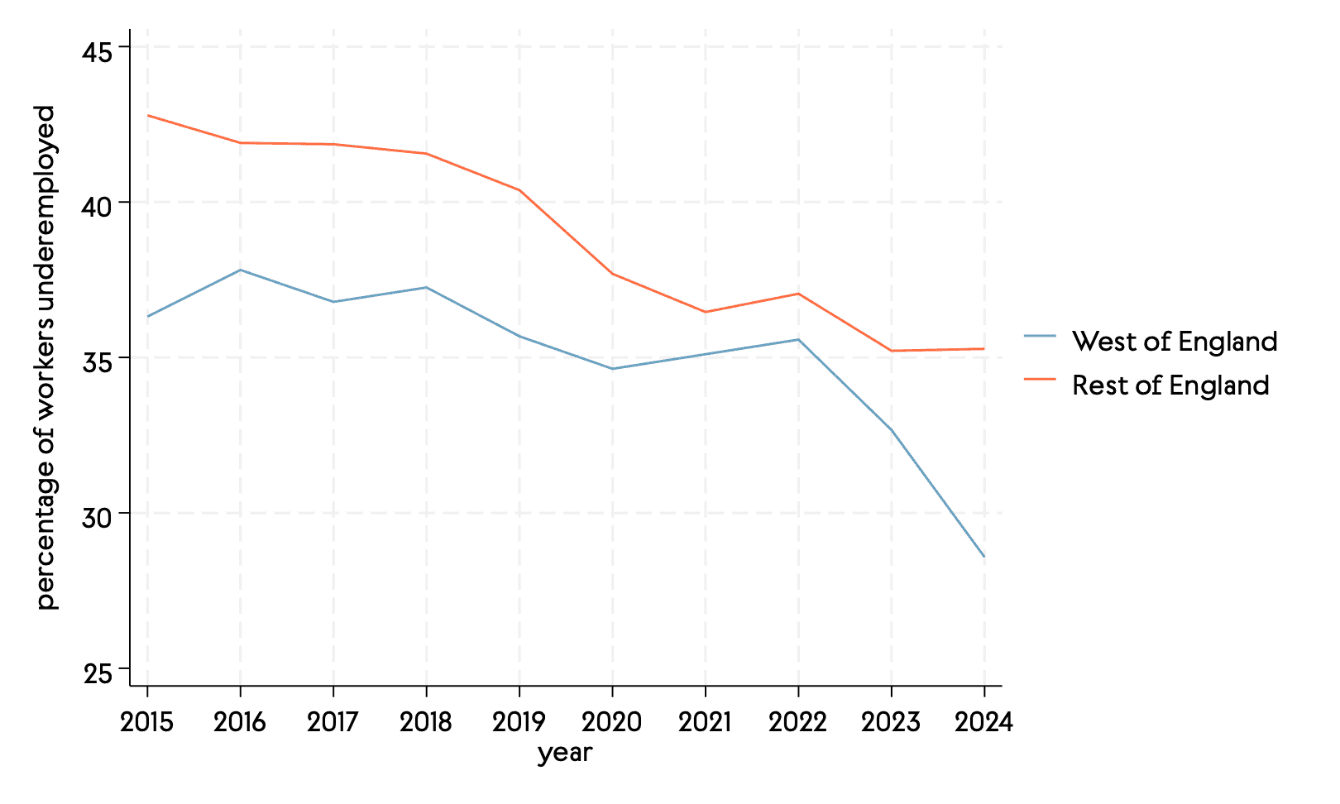
Source: Authors' calculation based on Annual Population Survey, 2015-24
These comparisons do not take worker characteristics into account. To see whether underemployment is due to the labour market or workforce characteristics, we estimate the likelihood of being underemployed while controlling for people’s education and other demographics. In other words, we compare workers with similar backgrounds across local authority areas.
The results give a detailed picture (see Table 2). Once we account for worker characteristics, some of the apparent differences between local authority areas reduce. The underemployment rates in Bath and North East Somerset, and North Somerset become very close to the rest of England average. The large difference between underemployment in England and in Bristol reduces substantially to just 2.2 percentage points (pp) (from 9.7pp) while South Gloucestershire is 1.2pp less likely to be underemployed compared to the rest of England. This suggests that some of the apparent differences between areas reflect the type of workers living in them, rather than the performance of local labour markets.
Table 2: Regression analysis of underemployment by West of England region
Area | Bristol | BANES | South Glos. | North Somerset |
Raw data | -0.097*** | -0.053*** | -0.012*** | -0.019*** |
Model | -0.022*** | 0.001 | -0.012** | 0.001 |
Source: Authors' calculation based on Annual Population Survey, 2015-24
Note: *** indicates statistically significant effect at the 1% level; ** 5% level.
The same approach applied to the graduate labour market shows similar results (see Table 3). The raw data suggest that three of the four local authorities have lower levels of graduate underemployment than the rest of England: Bristol (4pp lower), Bath and North East Somerset (2pp lower) and North Somerset (1.5pp lower). South Gloucestershire graduates, by comparison, seem more likely to be underemployed (1.9pp higher).
Once we control for worker characteristics, the picture changes. Graduate underemployment in Bath and North East Somerset and North Somerset is no different from the rest of England. Bristol’s underemployment rate remains clearly lower, with graduates living in the city around 3.3pp less likely to be underemployed than similar graduates elsewhere. In South Gloucestershire, controlling for characteristics reveals a larger disadvantage, with graduates 3.2pp more likely to be underemployed than comparable graduates nationally.
Table 3: Graduate underemployment by West of England region
Area | Bristol | BANES | South Glos. | North Somerset |
Raw data | -0.040*** | -0.020*** | 0.019*** | -0.015** |
Model | -0.033*** | 0.005 | 0.032*** | 0.007 |
Source: Authors' calculation based on Annual Population Survey, 2015-24
Note: *** indicates statistically significant effect at the 1% level; ** 5% level.
To understand how subject area shapes outcomes, we examine graduate underemployment by broad field of study. This is particularly relevant given that the West of England has a higher share of STEM graduates and fewer graduates in business, law and related subjects than the rest of England. The results show that Bristol’s low underemployment rate is driven mainly by graduates in business, law (5.8pp) and other non-STEM fields (4.1pp). STEM graduates living in Bristol have similar underemployment rates to their peers elsewhere.
In Bath and North East Somerset, graduates in business and law have higher chances of being underemployed than their equivalents nationally, although this difference does not translate into higher overall underemployment in the area because the numbers are small. In North Somerset, STEM graduates have lower underemployment than their equivalents nationally (3.6pp), but graduates in other fields have higher underemployment by 5.3pp. In South Gloucestershire, graduates in STEM and other non-business or law subjects experience a higher probability of underemployment by 3pp than similar graduates in England as a whole (see Table 4).
Table 4: Graduate underemployment by broad area of degree, full model results
Area | Bristol | BANES | South Glos. | North Somerset |
STEM | -0.012 | -0.011 | 0.031*** | -0.036*** |
Business, Law | -0.058*** | 0.050*** | 0.016 | 0.028 |
Other | -0.041*** | 0.007 | 0.038*** | 0.053*** |
Source: Authors' calculation based on Annual Population Survey, 2015-24
Note: *** indicates statistically significant effect at the 1% level.
A complementary analysis examines outcomes based on where graduates work rather than where they live (see Table 5). Graduates working in Bristol are less likely to be underemployed than graduates working elsewhere in England across all subject areas, reinforcing Bristol’s position as the strongest labour market for graduate job matching in the region.
In Bath and North East Somerset, the opposite pattern emerges. Graduates working there are more likely to be in non-graduate roles, particularly those with business or law degrees. In South Gloucestershire and North Somerset, graduates in non-STEM and non-business or law subjects are notably more likely to be underemployed compared with similar graduates elsewhere in the country.
Table 5: Graduate underemployment based on field of work
Area | Bristol | BANES | South Glos. | North Somerset |
STEM | -0.024*** | 0.022** | 0.001 | 0.018 |
Business, Law | -0.019* | 0.056*** | 0.010 | 0.028 |
Other | -0.018*** | 0.030*** | 0.030* | 0.088*** |
Source: Authors' calculation based on Annual Population Survey, 2015-24
Note: *** indicates statistically significant effect at the 1% level; ** 5% level, * 10% level.
Conclusion
The West of England has a lower underemployment rate compared with the rest of England. But, once we account for worker characteristics, the difference is smaller than the raw data suggest. Bristol and South Gloucestershire retain a modest gap with the rest of England average, while Bath and North East Somerset and North Somerset perform similarly to the country as whole.
Underemployment patterns also vary by field of study. While the West of England, especially Bristol, has a higher share of STEM graduates and fewer graduates in business and law than the rest of England, the results show that Bristol’s low underemployment rate is driven mainly by graduates in business, law and other non-STEM fields. STEM graduates living in Bristol have similar underemployment rates to STEM graduates elsewhere in the country.
We find differences linked to the sector mix found in local authority areas and commuting flows. Analysis based on where graduates work in the policy insight, Skills-Homes to Work, reinforces these broad regional dynamics and highlights that outcomes often reflect the distribution of jobs, rather than strict local authority boundaries.
Taken together, the findings suggest that there are opportunities to expand high-value employment across the West of England and to improve progression pathways so that residents in all areas can access jobs that make the best use of their skills.