economy
business
growth
Regional resilience: A story of faster growth in the West of England
The West of England’s rapid and sustained post-COVID recovery demonstrates its role as a driver of national growth. The information and communications sector stands out as one regional strength among many, while performance in other industries has been mixed.
This policy insight provides an overview of growth trajectories in the West of England between 2008 and 2023, and compares these with the wider South West region and with England as a whole. The West of England is defined as the West of England Combined Authority (WECA) area (Bristol, South Gloucestershire, and Bath and North East Somerset) and North Somerset. Growth – both for overall economic activity and within selected industries (using standard industrial classification, SIC, codes – is measured through compound average annual growth rates and real gross value added (GVA) indices year by year.
What does the evidence tell us?
The West of England's economy has grown at a significantly higher rate since the COVID-19 pandemic than the rest of England. Up until 2020 – including through the disruptions of the global financial crisis and withdrawal from the European Union (EU) – the region's performance had followed a similar pattern to the rest of the country, but it accelerated thereafter.
But the story of the economy as a whole masks significant differences within and between sectors. The information and communication sector, for instance, expanded at 8.6% annually between 2008 and 2023, driven by strengths in emergent knowledge-intensive subsectors like software development and digital media. Financial services, on the other hand, shrank in the region over this period.
The professional, scientific and technical activities sector is one that has seen strong growth, but the topline figures cover up a notable decline in gross value added (GVA) – a measure of the value of goods and services produced – contributed by the head offices and management consultancy subsector.
Local government must therefore balance the needs of the region’s strong enterprising culture that catalyses growth through emergent and innovative businesses with incentives that attract and retain centralised corporate decision-makers. This can be achieved through expansion of existing inward investment strategies, working with existing industry and public bodies to deliver sector-focused regional branding (for example targeted headquarter attraction campaigns) that highlight local strengths, such as strong talent supply and quality of life.
How have different sectors performed?
The economy – nationally, regionally and locally – has experienced multiple disruptions since the early 2000s, including the global financial crisis, Brexit and the COVID pandemic. Examining different business sectors across this period therefore shows which have proven resilient and which have been affected by structural factors limiting growth.
Table 1 summarises growth in real GVA by industry between 2008 and 2023, displaying the compound average annual growth. This measurement is preferred over a simple linear average because it accounts for the compounding nature of growth over time, providing a more accurate reflection of the long-term performance of these sectors.
Table 1: Average annual real GVA growth by selected Industries, 2008-23 (West of England vs England)
Industry Descriptions | West of England (%) | England (%) |
ALL INDUSTRIES | 1.9 | 1.35 |
Production sector | -0.53 | 0.27 |
Manufacturing | -1.33 | 0.32 |
Manufacture of basic and fabricated metal products | 1.16 | 0.29 |
Manufacture of electrical products and machinery | 1.48 | -0.12 |
Construction | 1.99 | 1.21 |
Civil engineering | 1.52 | 1.28 |
Specialised construction activities | 2.88 | 1.57 |
Services sector | 2.31 | 1.52 |
Wholesale and retail trade; repair of motor vehicles | 1.25 | 0.2 |
Motor trades | 1.7 | 0.37 |
Wholesale trade | 2.04 | 0.38 |
Transportation and storage | 1.3 | 0.06 |
Information and communication | 8.64 | 6.84 |
Publishing; film and TV production and broadcasting | 3.92 | 0.1 |
Financial and insurance activities | -3.46 | -1.03 |
Real estate activities | 3.31 | 2.06 |
Real estate activities, excluding imputed rental | 5.05 | 3.83 |
Owner-occupiers' imputed rental | 2.67 | 1.38 |
Professional, scientific and technical activities | 2.94 | 2.03 |
Legal and accounting activities | 5.22 | 2.52 |
Head offices and management consultancy | -10.83 | 2.68 |
Architectural and engineering activities | 2.58 | 1.02 |
Other professional, scientific and technical activities | 2.25 | 1.23 |
Administrative and support service activities | 6.39 | 3.12 |
Rental and leasing activities | 14.68 | 1.71 |
Services to buildings and landscape activities | 5.01 | 4.8 |
Office administration and business support activities | -11.24 | 5.12 |
Source: Office for National Statistics (ONS), Regional gross value added (balanced) by industry (local authorities).
Three distinct trajectories appear from these sectoral growth rates since 2008.
The digital and business services economy has expanded faster than England averages, driven by growth in information and communication and administrative services. This signals the emergence of new business models and markets, particularly in software development, digital media and outsourced business functions.
Steady expansion in sectors such as professional services, construction and real estate reflect the region's core strengths and the reinforcing relationship between population growth and demand for property development and professional services.
Finally, there has been a sharp contraction in the region's financial services (-3.46%) and especially management consultancy (-10.83%). These figures reflect limited foreign direct investment (FDI) into the West of England and suggest that the region has not captured its share of these high-value activities despite strong performance in related professional services.
How has the West of England economy performed over time?
The growth rates summarised in Table 1 capture the overall (net) change between 2008 and 2023 but obscure the pattern of when these changes occurred. As a result, it is important to trace real GVA indices year by year (using 2008 as the baseline).
This analysis shows that the West of England's economy grew much faster from 2020 onwards. Having weathered successive disruptions – including the global financial crisis, uncertainty around Brexit and the COVID pandemic – without major deviation from national trends, it appears that the region has experienced a markedly stronger recovery than many other parts of England.
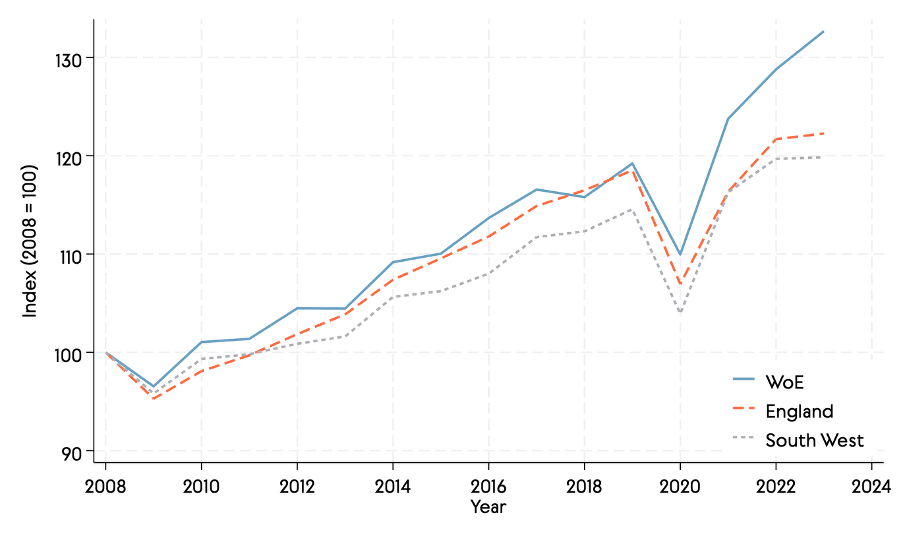
Figure 1 illustrates the overall growth trajectory through the West of England's real GVA index from 2008 to 2023, and compares this with England and the broader South West. As shown, there was a modest fall in the real GVA index around 2008-09 in all three geographies. Through most of the 2010s, the regional path did not depart significantly from the national trend.
As mentioned, the key divergence emerges around the pandemic. While all areas experienced a sharp drop in 2020, the West of England's recovery is noticeably stronger, with the index rising above its pre-COVID level more quickly and ending the period higher than England.
Figure 1: Growth trajectory of the overall economy, 2008-23
Source: Calculated as an index using ONS regional GVA, chained volume measure, 2022 prices.
Which industries have contributed to, or hindered regional growth?
As with the analysis above, an exploration of real GVA indices year by year that focuses on sectors can reveal how different areas of the economy were affected by (and responded to) successive economic disruptions, showing which industries drove the post-pandemic acceleration in the West of England, and which held it back.
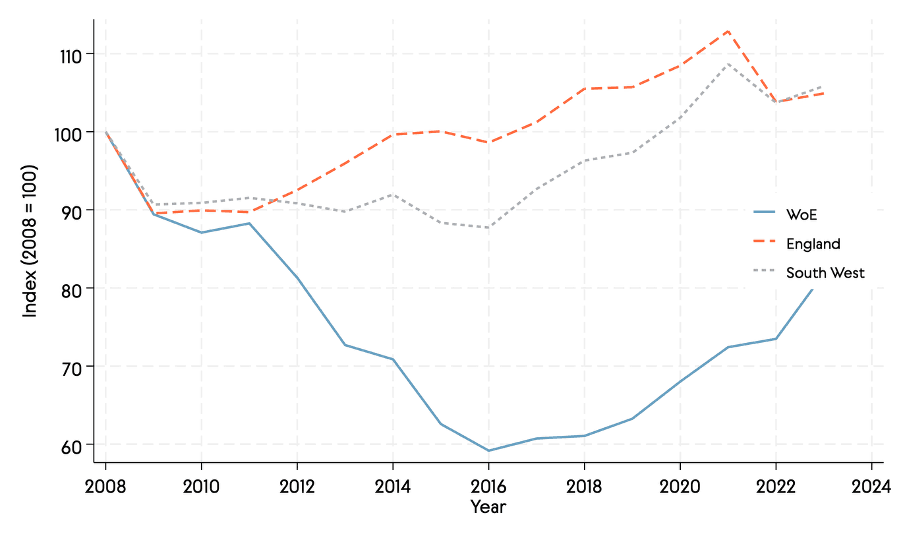
Manufacturing has shown sluggish performance in the West of England relative to England as a whole (as shown in Figure 2). Following the global financial crisis, manufacturing across England experienced a modest dip in growth before recovering to exceed its 2008 level by 2023. The West of England followed a dramatically different path. The regional index declined sharply and continuously from 2008 through to around 2016-17, indicating a contraction of some 40% in real terms. From 2017 onwards, there are signs of partial recovery with the regional index rising gradually. Nevertheless, this remains substantially below both the 2008 baseline and the trajectories of England and the wider South West.
The depth and duration of this regional underperformance warrant careful interpretation. This may reflect the composition of the regional manufacturing base: the West of England is reliant on aerospace and advanced engineering, both sectors that faced headwinds during this period, including defence budget pressures and COVID-related reduction in demand.
While the manufacturing industry in the region has not recovered to 2008 levels, the growth seen since 2017 has coincided with renewed investment in aerospace and the emergence of new advanced manufacturing activities. This could be a positive sign for the future, but whether it represents the beginning of sustained rebuilding remains to be seen.
Figure 2: Growth trajectory of manufacturing industry, 2008-23
Source: Calculated as an index using ONS regional GVA, chained volume measure, 2022 prices.
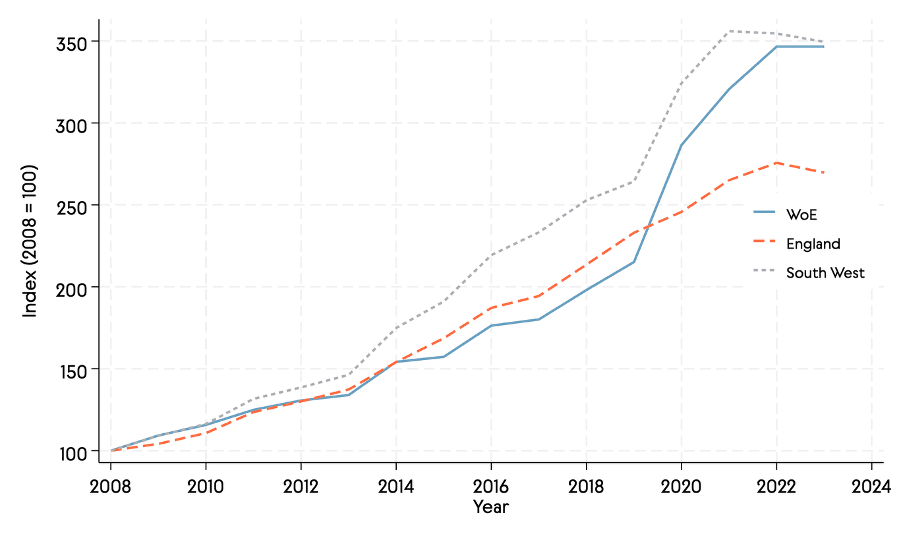
In contrast, the index for information and communication activities has been rising at a faster rate than all other sectors from 2008 to 2023 (see Figure 3). The index for the West of England more than triples in real terms over this period, highlighting the sector’s remarkable resilience to macroeconomic disruption.
Within the sector, digital and creative activity is distributed broadly across the region rather than concentrated solely in the West of England's urban centres, as indicated by the South West's outperformance of both other geographies. The sector's exceptional growth and relative immunity to the disruptions that affected other parts of the economy underscore its increasing importance to the regional economic base.
Figure 3: Growth trajectory of information and communications sector, 2008-23
Source: Calculated as an index using ONS regional GVA, chained volume measure, 2022 prices.
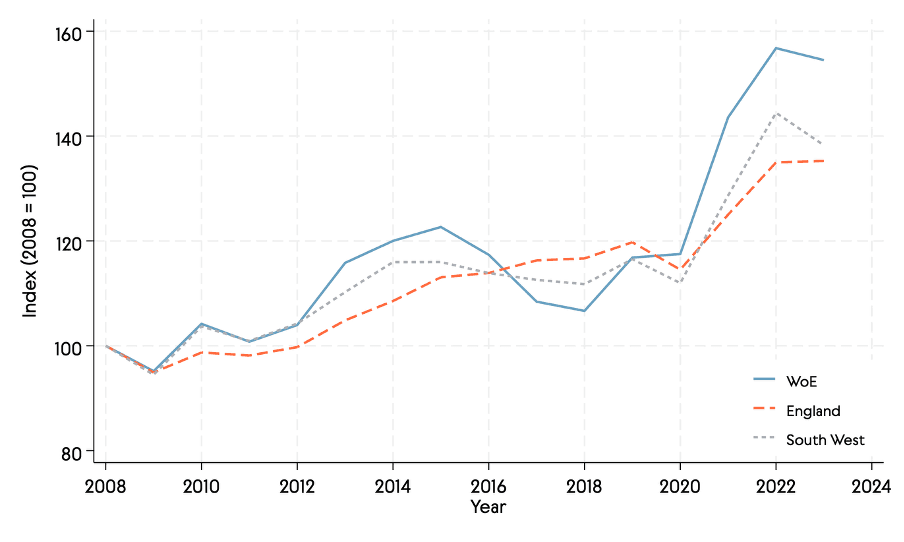
Across professional, scientific and technical activities, the West of England's trajectory from 2008 to 2023 has been notably more volatile than England's steady upward path (see Figure 4). This suggests that the sector may be more sensitive to macroeconomic conditions.
This industry recovered from the 2007-09 financial crisis more quickly in the West of England than other areas and maintained a lead over England through the early-to-mid 2010s. This advantage eroded markedly from 2016 onwards, however, with the regional index declining while England’s continued its gradual ascent. By 2018-19, professional, scientific and technical activities in the West of England had fallen below the national benchmark. While we cannot be certain about the cause of this dip, the pattern is consistent with Brexit-related uncertainty affecting demand for professional and advisory services.
This trend was strikingly reversed after 2020, when growth in this sector accelerated in the West of England, substantially outpacing England. By 2023, the region had established a clear lead over national trends. This surge, concentrated in the immediate post-pandemic years, accounts for much of the region's overall outperformance across the 15-year period, with the sector representing the largest share of both GVA and number of enterprises in the region. The mechanisms driving this acceleration therefore warrant further investigation below.
Figure 4: Growth trajectory of professional, scientific and technical activities, 2008-23
Source: Calculated as an index using ONS regional GVA, chained volume measure, 2022 prices.
How have industries in the professional, scientific and technical sector faired?
The categories above offer insights into broad sectors within the economy, but further examination into subsectors can uncover what might be driving or holding back growth.
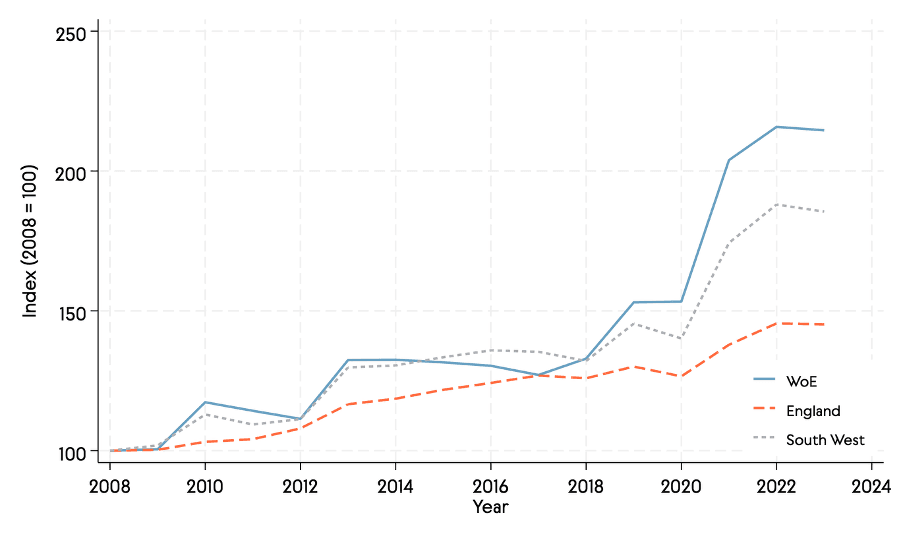
Legal and accounting activities is one such sub-category of the professional, scientific and technical sector and one that has shown sustained and substantial growth between 2008 and 2023. The West of England has increasingly outperformed England throughout the period (see Figure 5). The subsector has demonstrated remarkable resilience to macroeconomic disruptions. The 2007-09 global financial crisis did not lead to any visible contraction; instead, growth continued uninterrupted. Similarly, the Brexit referendum in 2016 appears to have had no discernible negative impact; if anything, the regional trajectory steepens in subsequent years. This possibly reflects an increased demand for legal and advisory services related to regulatory change and corporate restructuring following the UK's exit from the EU.
The most striking feature is the sharp post-2020 acceleration in legal and accounting activities in the region. While the pandemic might have been expected to disrupt client-facing professional services, the West of England's legal and accounting sector surged dramatically, with the gap over England widening substantially. By 2023, the region had more than doubled its 2008 output in real terms, while national growth in the sector remained considerably more modest. This exceptional trajectory underscores the region's deep specialisation in knowledge-intensive business services.
Figure 5: Growth trajectory of legal and accounting services, 2008-23
Source: Calculated as an index using ONS regional GVA, chained volume measure, 2022 prices.
The experience of head offices and management consultancy activities is very different (see Figure 6). These subsectors are analysed jointly because both perform enterprise-level management and control functions, including corporate oversight, strategic coordination and advisory services, and therefore indicate where high-level decision-making capacity is concentrated within the economy.
Regional divergence is most pronounced in these sectors. Until around 2015, the West of England tracked broadly in line with England, but from 2016 onwards they diverged sharply. England then entered a period of sustained growth, rising steadily through to 2023, while the West of England began a steep and sustained collapse. By 2018, the regional index had fallen to around half its 2008 level, followed by a brief stabilisation around 2019-20. But this proved temporary, and the decline resumed and accelerated thereafter.
The timing of this divergence is notable. The initial break occurs around 2015-16, consistent with Brexit-related uncertainty, potentially prompting headquarter relocations or consolidations. However, the steepest phase of decline occurs after 2020, suggesting that pandemic-era restructuring – including shifts to remote working that may have reduced the rationale for maintaining regional offices – compounded earlier losses.
Figure 6: Growth trajectory of head offices and management consultancy services, 2008-23
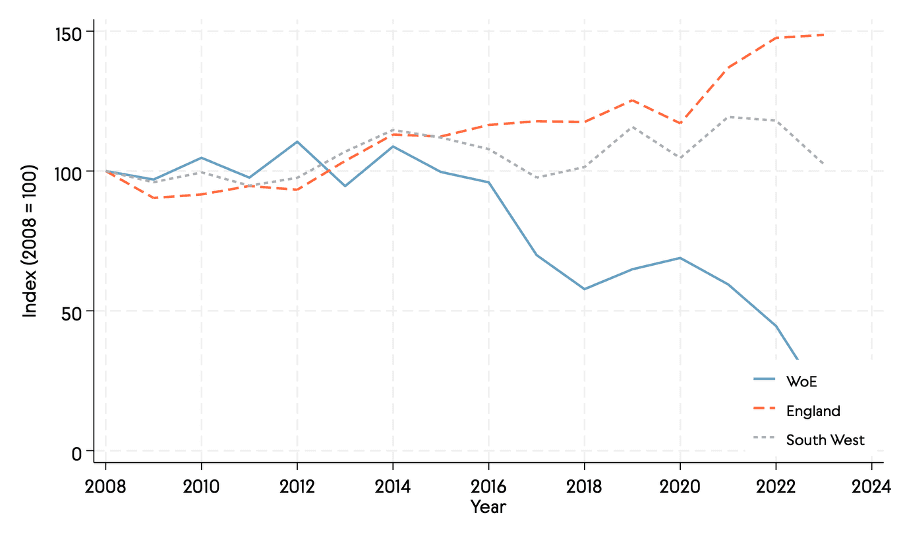
This pattern points to a significant area for economic development in the West of England. Although the region has grown strongly in professional services that support businesses, it has lost ground in hosting corporate headquarters and strategic consultancy functions that anchor high-value decision-making.
The implications of this merit further investigation as the causes of decline remain unclear from the available evidence. Addressing these issues presents a significant opportunity for the West of England as headquarters typically support regional economies through direct employment and substantial procurement and supplier relationships.
Conclusion
Strong regional growth is driven by existing and emergent knowledge-intensive industries and businesses, and some resilience in core industries such as rental services and wholesale trade. Within headline growth trends, however, a precipitous decline in some significant areas – such as manufacturing and head offices – suggests that the region excels at generating and developing enterprises but may face constraints on retaining physical and corporate business centres as firms mature and respond to national and international instability.
These findings highlight the importance of a region-wide emphasis on emerging markets and opportunities, as sectors that fail to adapt over time are more exposed to external global shocks. Businesses should capitalise on existing support for business model development and actively provide feedback on programme effectiveness to inform continued place-based development.
Local government should continue to strengthen collaboration with the region’s enterprising firms and ecosystems that catalyse growth through innovation. But it should also work to counteract the impact of global disruptions on core businesses. Declining high-value sectors such as head offices and management consultancy can be targeted, for instance, through expanded inward investment strategies and sector-focused branding for the West of England. This could include targeted attraction campaigns that can be delivered in partnership with industry and public bodies.
Future research should investigate what is causing these trends, examining the top-down impact of global disruptions as well as the ground-up perspectives of businesses and the effects of local policy environments. This could enable future policy to support the regional business environment as both a site of emerging and scaling enterprises and long-term corporate development with strong connections to the wider economy.