skills
employment
international
Migration trends and higher education in the West of England
Migration in the West of England has grown at a faster pace than other combined authorities in England, albeit from a lower base. Recent change has been shaped by non-European Union (EU) inflows and the rising number of international students, rather than long-established settlement.
This policy insight assesses migration patterns in the West of England (Bath and North East Somerset, Bristol, South Gloucestershire and North Somerset) relative to those in comparable combined authorities. Migration trends by country of birth and nationality, with a particular focus on the impact of international higher education students on population change, are analysed using data from the Office for National Statistics (ONS) and Higher Education Statistics Agency (HESA).
Migrants represent a smaller share of the West of England's population than in other, larger combined authority areas. But migration to the region has expanded in recent years, resulting in a more diverse migrant population. The rise has been particularly pronounced among people arriving from outside the EU and international students.
Given the region’s strong concentration of research-intensive universities and knowledge-intensive industries, migration plays an important role in supporting labour markets, complementing local skills and sustaining innovation. In this context, the economic importance of migration for the region is determined less by its overall size and more by the characteristics of the migrant population and how it interacts with the local industrial structure.
For public policy, this suggests the need for closer alignment between regional economic strategy, migration pathways and national migration policy. Improved local monitoring of skills needs, stronger coordination between universities and employers to facilitate transitions from study into skilled employment, and targeted measures to retain STEM (science, technology, engineering and mathematics) graduates can help to strengthen productivity gains in the region.
Migration national context
Since 2020, the UK’s migration system has undergone significant change, driven by Brexit, labour market disruptions caused by COVID-19 and tighter immigration policies. The end of EU free movement in January 2021 marked a fundamental shift, replacing nationality-based entry with a points-based system focused on skills and labour market priorities. In the immediate aftermath of Brexit, EU net migration turned negative, with departures (outflows) exceeding arrivals (inflows) from 2022 onwards. This decline was offset by a sharp rise in non-EU migration between 2021 and 2023, which has since declined following the introduction of new restrictions (ONS, 2025)
These shifts have had measurable economic impacts. Reductions in worker movement due to Brexit have been linked to greater challenges for international trade and extra costs for industries as they adapt to regulatory changes (Breinlich et al., 2021; Novy et al., 2024). Across the UK, reductions in EU migration appear to have contributed to labour shortages in specific sectors, including health, social care and hospitality (Portes and Forte, 2017; Portes, 2024).
Migration also plays an important role in regional productivity. In the UK, skilled migrants contribute positively to local innovation performance and productivity (Gagliardi, 2015; Campo et al., 2024), whilst also being linked to innovation and knowledge creation, increased patenting and knowledge spillovers (Hunt and Gauthier-Loiselle, 2010; Akcigit, Grigsby and Nicholas, 2017).
These innovation-enhancing effects of migration appear particularly pronounced in regions with strong research institutions and established innovation ecosystems. The West of England’s economy is characterised by research-intensive universities, a high proportion of professional roles, and sustained demand in health and social care – migration is therefore likely to have a significant impact on the region. Changes to skilled worker routes, student migration and salary thresholds may affect both labour supply and innovation capacity. Understanding both the scale and composition of migration flows is therefore central to assessing regional labour market needs and economic performance.
Migration trends in the West of England and similar combined authorities
This analysis situates migration trends in the West of England within a comparative framework across selected combined authorities over the period 2010-23. The analysis distinguishes between population shares (levels) and indexed growth (2010=100) to separate differences in scale from differences in trajectory.
Across the 2010-23 period, the West of England had a lower share of non-UK-born population (around 10% on average) than the West Midlands, Greater Manchester and Cambridge and Peterborough (see Figure 1.1 and 1.2). The region’s position relative to other combined authorities has remained broadly stable over time, reflecting both its smaller metropolitan scale and its more recent development as a destination for migration.
Nevertheless, the share of the population born outside of the UK rose steadily over the period. This increase has been gradual and does not seem to have altered the overall ranking across combined authorities.
Figure 1.1. Migrant population share by country of birth in selected regions, 2010-2023
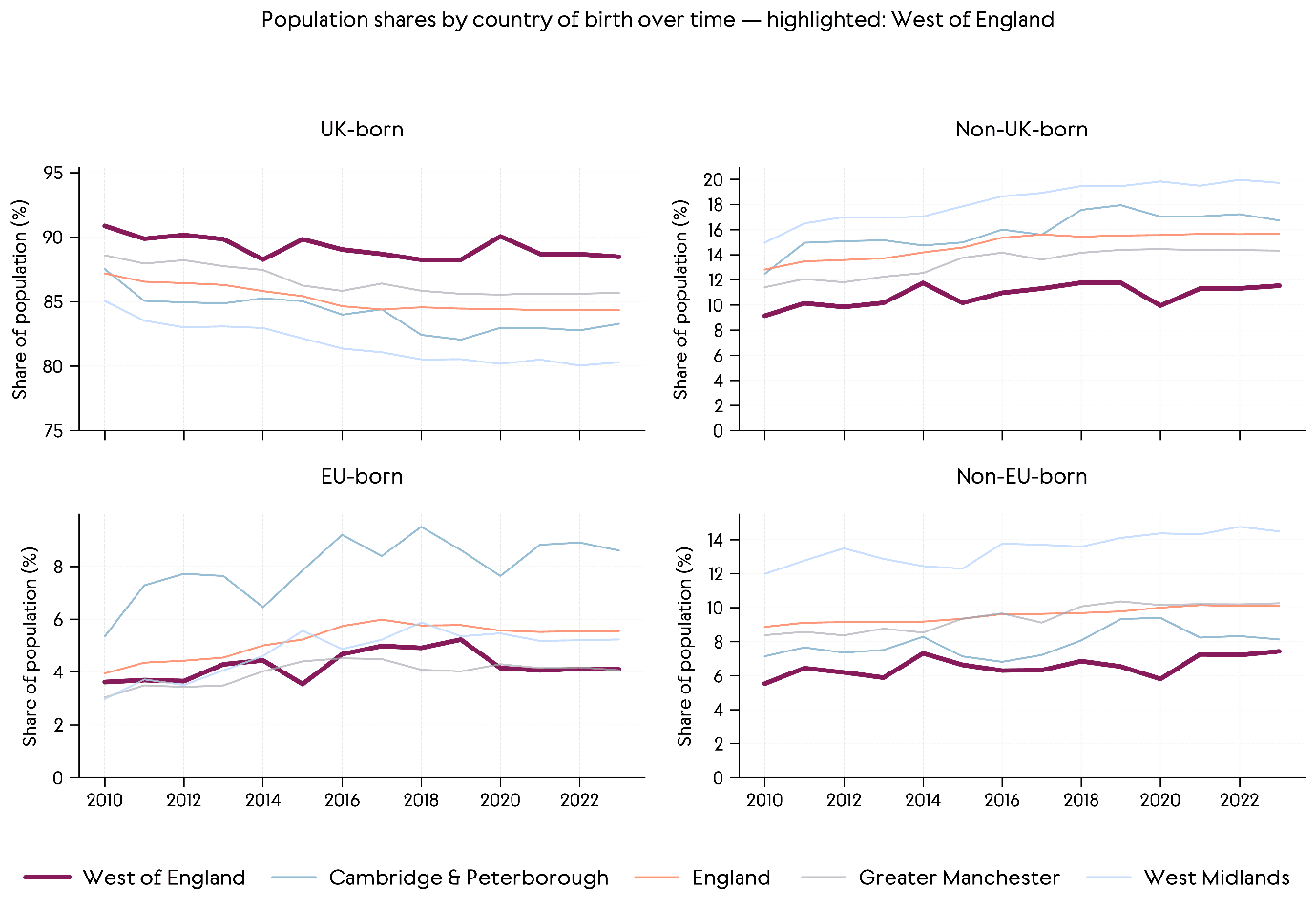
Figure 1.2. Migrant population share by country of birth in selected regions, 2010-2023
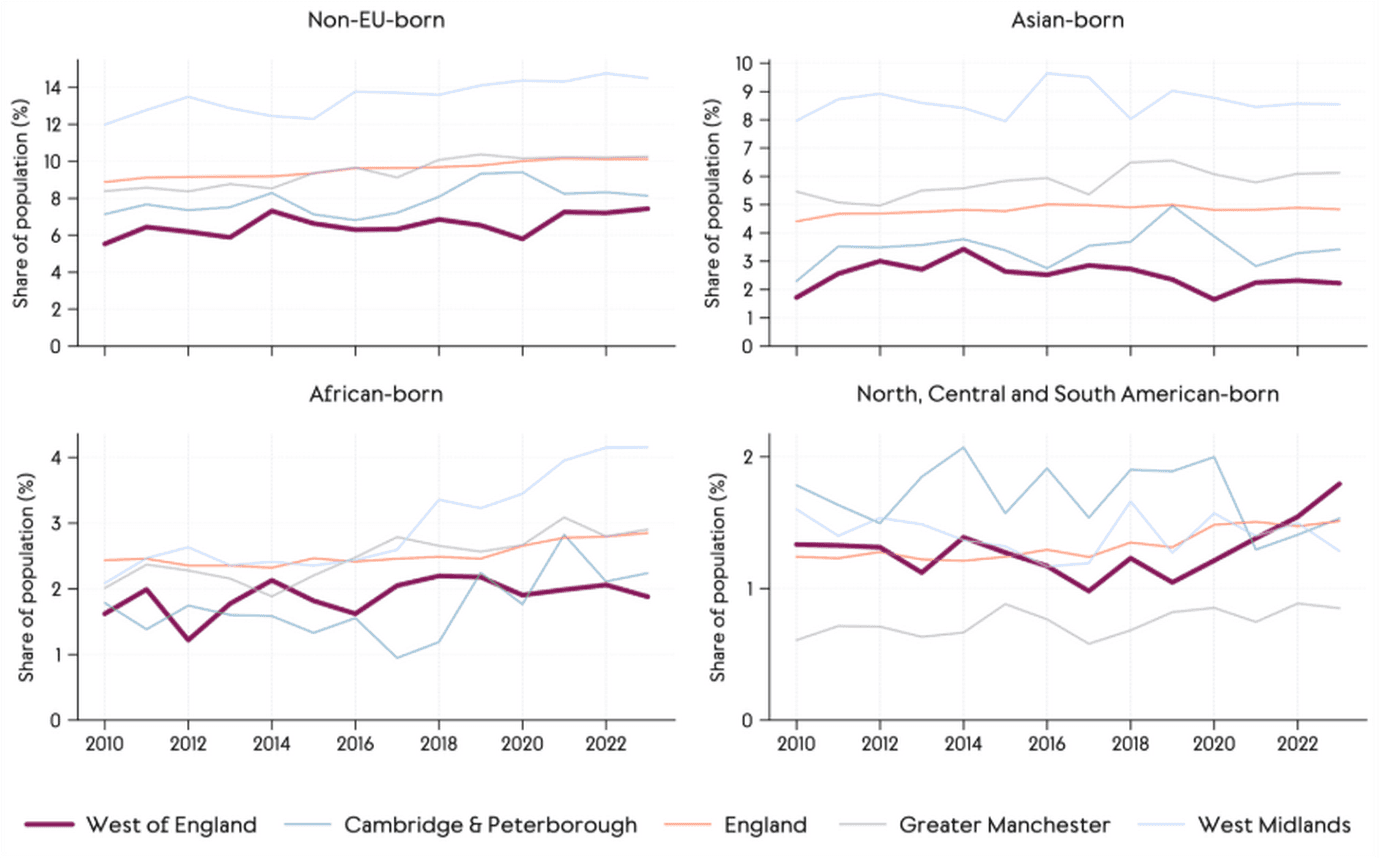
Source: NOMIS, ONS annual population estimates, 2010-2023.
Notes: Non-UK-born population includes EU-born and non-EU-born. The population share of non-EU-born is disaggregated by Asian-born, African-born and North, Central and South American-born as shown in figure 1.2.
The EU-born population accounted for a substantial share of the migrant population during the first half of the 2010-23 period (representing roughly 4 percentage points of the total non-UK-born share of around 10%). This fluctuated around the time of the 2016 Brexit referendum vote and softened slightly toward the end of the period. In contrast, there was a more sustained rise in the proportion of migrants from outside of the EU, particularly those born in Asia, during the first half of the 2010s, followed by some decline in later years. On average, the Asia-born population accounts for around 2 percentage points of the total non-UK-born share.
The origin of migrants varies across the regions (see Figure 1.2). The Africa-born population and the North, Central and South America-born population remain comparatively small in absolute terms but have gradually and incrementally grown over time. In comparative terms, the West Midlands, Cambridge and Peterborough, and Greater Manchester have higher shares of non-UK born population (20%, 17% and 14% in 2023, respectively) compared with 12% in the West of England. These other combined authority areas also have a more diverse migrant population, particularly in terms of those born in Asia and Africa, but the composition of the migrant population in West of England is gradually broadening.
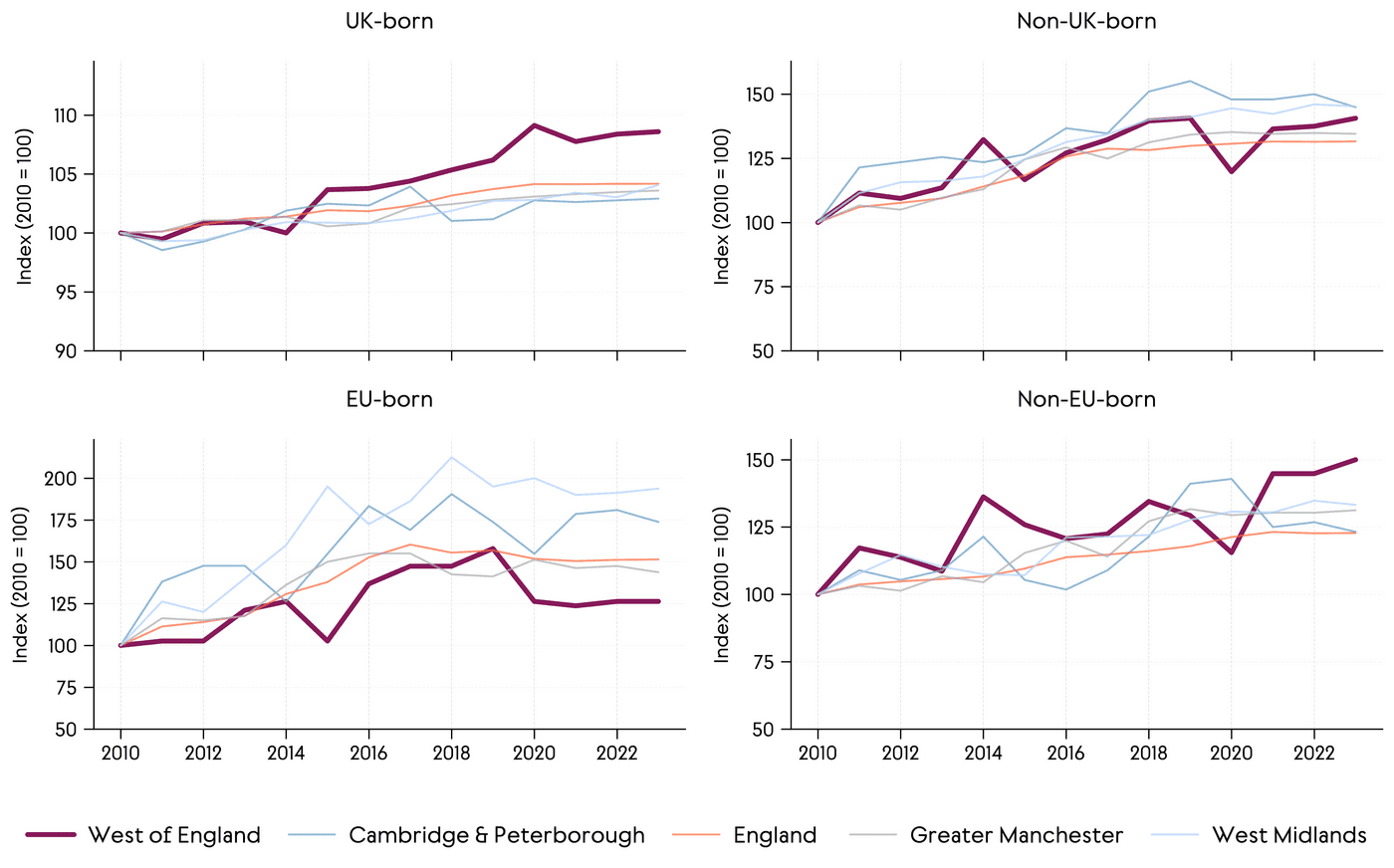
Although starting from a lower base level, the West of England has experienced comparatively high growth in migration compared with other combined authority areas across the period (2010-23). The 30% increase relative to the baseline year is a notable acceleration in the non-UK-born population (see Figure 2). In proportional terms, however, this trajectory broadly keeps pace with those observed in larger combined authorities.
Figure 2.1: Migrant population growth by country of birth in select regions, 2010-23, (index 2010=100)
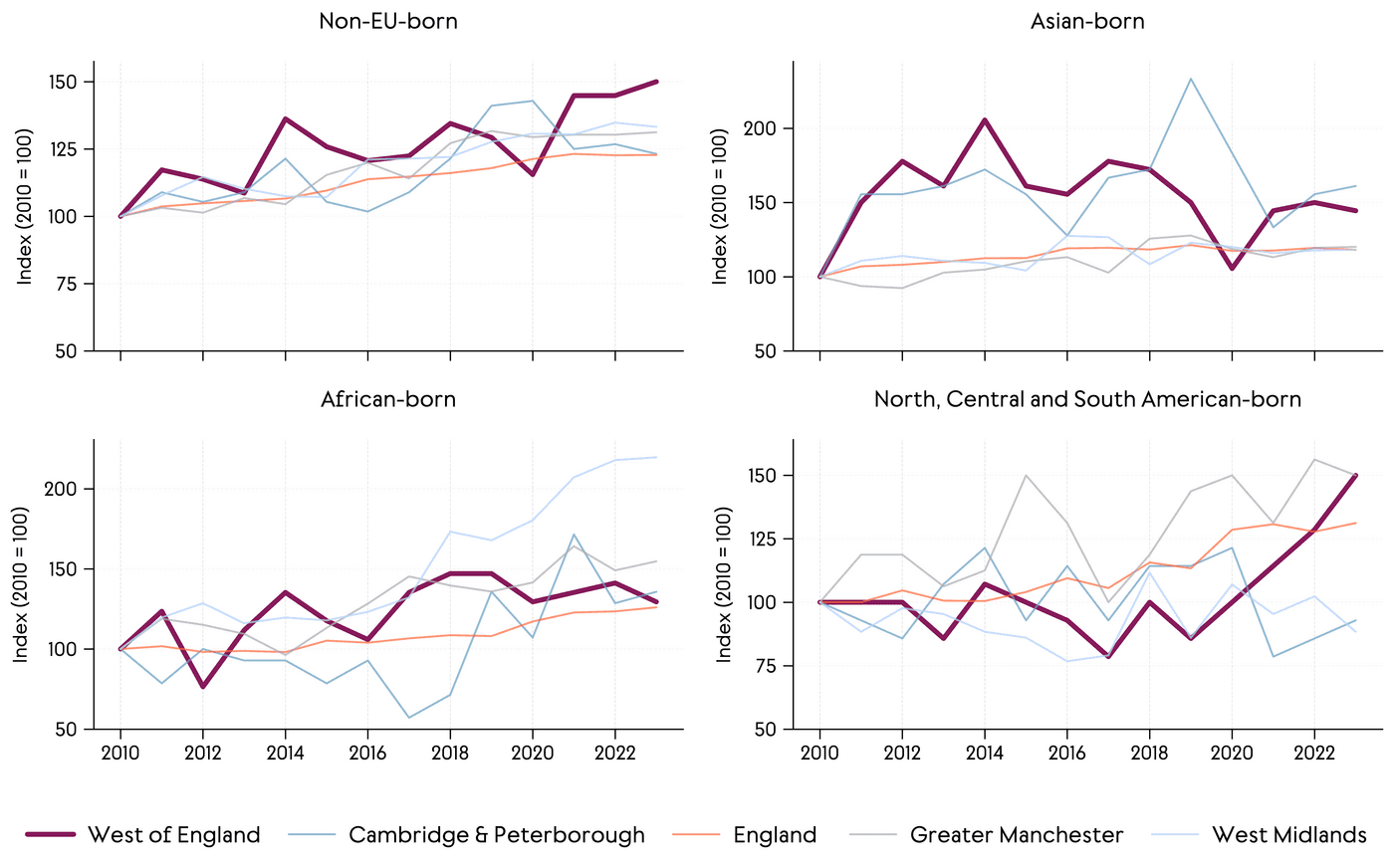
Figure 2.2: Migrant population growth by country of birth in select regions, 2010-23, (index 2010=100)
Source: NOMIS, ONS annual population estimates, 2010-23
Notes: Highlighted the West of England; index (2010 = 100). Non-UK-born population growth includes EU-born and non-EU-born. The population growth of non-EU-born is disaggregated by Asian-born, African-born and North, Central and South American-born.
The number of EU-born migrants in the West Midlands and Cambridgeshire and Peterborough nearly doubled relative to 2010 figures over the period; while EU-born migration grew at a much slower pace in the West of England, Greater Manchester and the England average. The rise in EU-born migration numbers was punctuated by noticeable slowing and reductions around the 2016 Brexit referendum and during the COVID-19 pandemic. These episodes interrupted an otherwise upward trajectory, highlighting the sensitivity of EU migration flows to policy and economic shocks.
The growth of the non-EU born population is pronounced in the West of England, driven by an 100% increase in the Asian-born population in the first half of the 2010-23 period relative to the 2010 baseline. Although this was followed by a partial reversal in later years. In contrast, the rise in the Africa-born population was steadier toward the end of the period, while the North, Central and South American-born population expanded following the COVID-19 pandemic, pointing to a gradual diversification in the region even where initial population shares were comparatively small.
These figures emphasise the importance of distinguishing between absolute numbers and relative growth. In terms of population shares, the West of England consistently remains below the West Midlands and Greater Manchester across all major origin groups. But in growth terms, there has been rapid expansion similar to some larger combined authorities, particularly from the mid-2010s onwards.
This contrast highlights differences not only in scale but also in the stability and composition of diversification across the combined authorities. The West Midlands and Greater Manchester exhibited stronger and more sustained growth across multiple origin groups, especially among Asia- and Africa-born populations, consistent with their roles as long-established migration destinations. By comparison, the West of England combined lower overall levels with sharper year-to-year fluctuations and greater sensitivity to external shocks. While this points to a more undefined trajectory, it also signals a gradual broadening in origin composition.
Migration and higher education: talent and opportunities
The growing diversity in migrant origins observed in Figures 1 and 2 has implications for the West of England economy. Existing research suggests that this could be associated with the diversification of skills and occupation profiles, which can affect the matching between people and jobs, the sharing of knowledge and the potential for innovation. (Nathan, 2015; Lee, 2015).
In regions with strong higher education and knowledge-intensive activity, such diversification can support innovation through the contribution of favourable skills and associated knowledge spillovers (OECD, 2022). For example, student migrants tend to be highly educated and in the early stages of their careers, contributing to host economies both directly, through tuition fees, taxes and consumption expenditure, and indirectly, through knowledge spillovers and labour market participation.
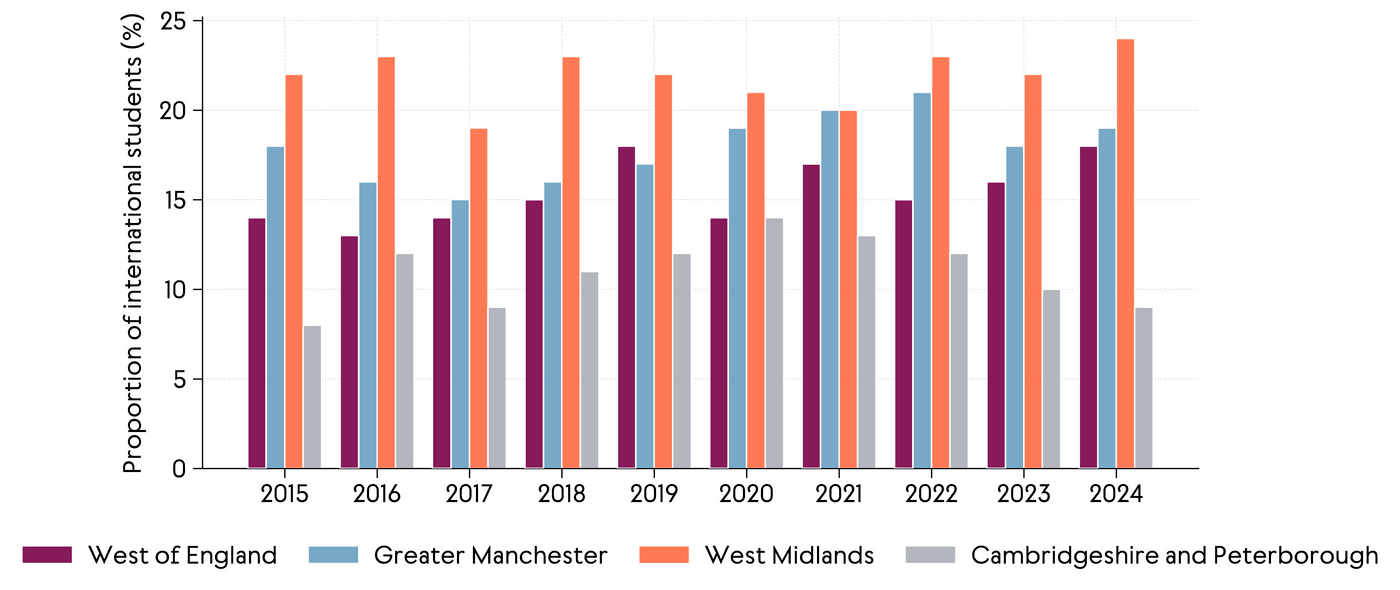
The West of England hosts several major universities, including the University of Bristol, the University of Bath, the University of the West of England and Bath Spa University. The share of international students studying in the region (relative to the total student body) has grown, rising from 14% in 2015 to 18% by 2024 (see Figure 3). In contrast, although the West Midlands and Greater Manchester had a larger proportion of international students in 2015 (22% and 18% respectively), they show a steadier trajectory with lower change.
Figure 3: Proportion of international students among total students by select region, 2015-24
Source: HE Student Data, HESA.
Note: The analysis highlights the degree of internationalisation of regional higher education systems rather than their absolute size.
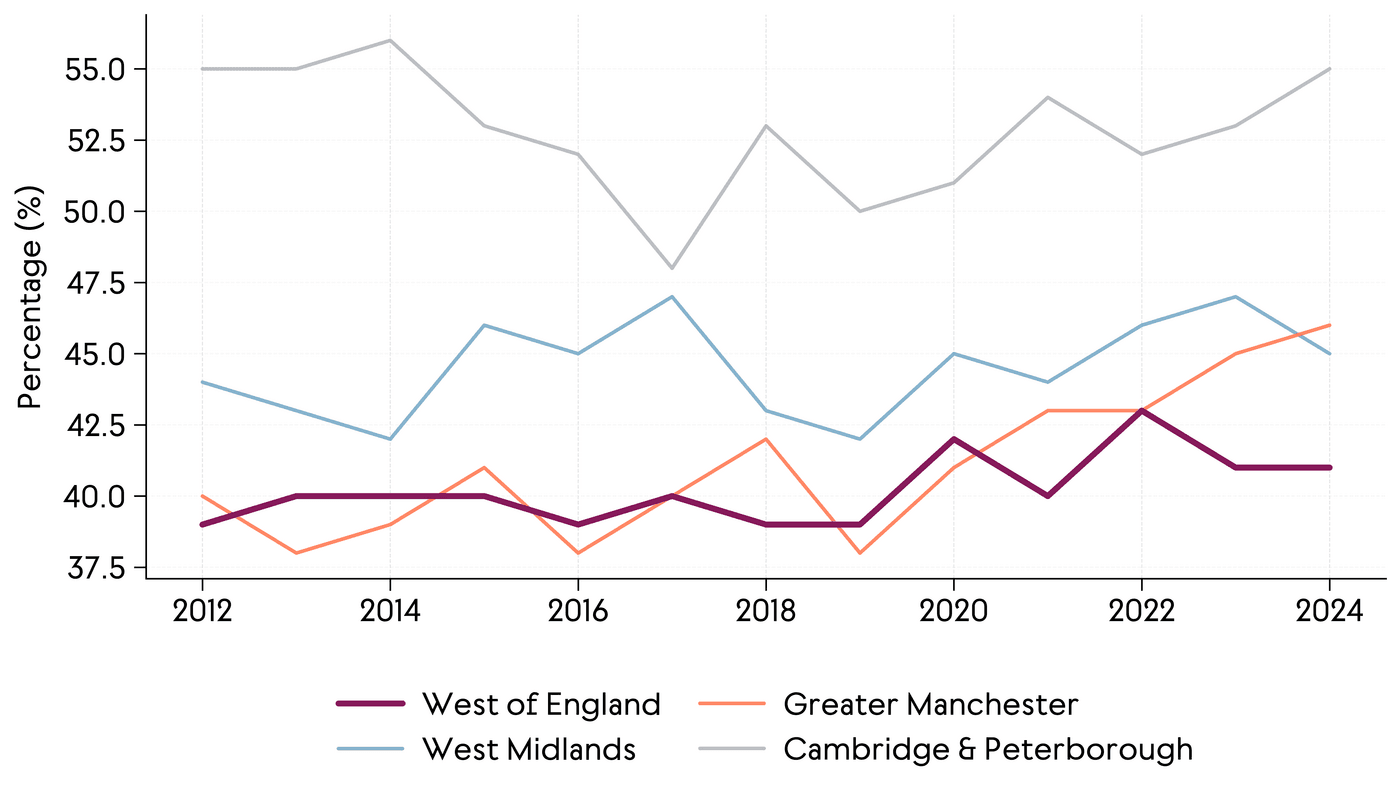
In the West of England, around 40% of international students are enrolled in STEM subjects, which is comparable to Greater Manchester and slightly less than in West Midlands (see Figure 4). In Cambridge and Peterborough, more than half of international students are in STEM, but this has been declining.
Figure 4: Proportion of STEM students among international students in select regions, 2012-24
Source: HE Student Data, HESA.
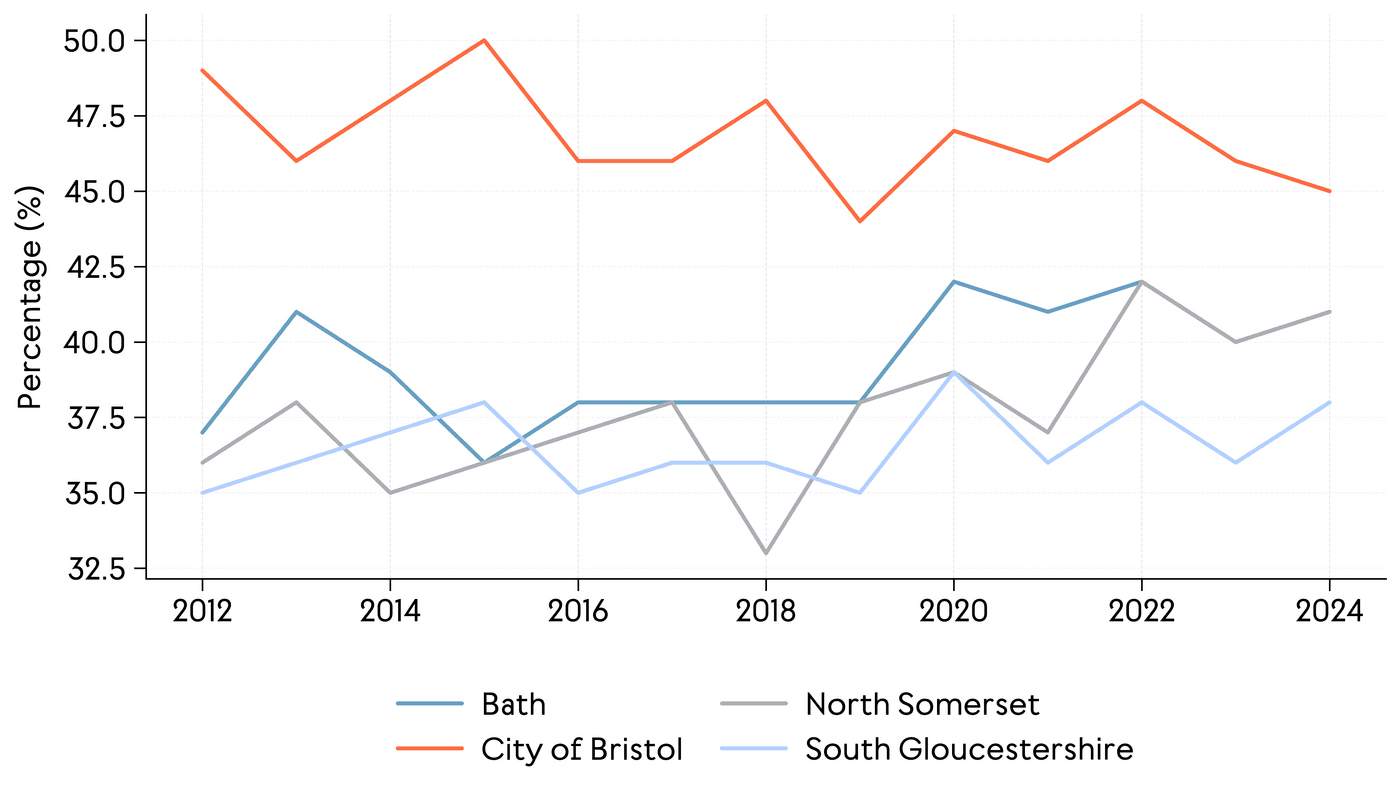
There is some variation between the local authorities in the West of England in terms of the proportion of international students studying STEM subjects (see Figure 5). Around 50% of international students in Bristol are in STEM fields, while the share is lower in the other local authorities. Notably, when looking at the total West of England labour market, 47.3% of graduates in the region have their highest degree in a STEM subject, 4 percentage points higher than the England average.
The concentration of international students in STEM fields is particularly relevant for regional innovation systems. STEM-oriented migrants contribute disproportionately to patenting, entrepreneurship and productivity growth (Hunt and Gauthier-Loiselle, 2010). Regions with strong higher education institutions and research-intensive ecosystems may therefore benefit from complementarities between international students and local firms in knowledge-intensive sectors (Valero and Van Reenen, 2019).
Figure 5: Proportions of STEM students among international students in the West of England, 2012-24
Source: HE Student Data, HESA.
Still, concerns remain about the impacts of migration on the labour market, particularly on wages and employment. Evidence in the UK has broadly found that migration has little effect on average wages, with the labour market adapting through changes in job roles and task specialisation, rather than by displacing workers (Dustmann, Frattini and Preston, 2013; MAC, 2018). This suggests that international students, particularly those entering skilled jobs, support economic growth through higher productivity rather than by affecting local wages. To understand how this is happening in the UK and the West of England, analysis of further data is required.
Conclusion
Migrants make up a smaller share of the West of England's population than in larger combined authorities. Nevertheless, the population born outside of the UK is growing and diversifying, especially with rising numbers of non-EU nationals and international students. Given the region’s concentration of research-intensive higher education institutions and knowledge-intensive sectors, migration helps the labour market adapt, makes better use of diverse skills and drives innovation. This means that the economic impact of migration depends less on its scale and more on its composition and fit with the local economy.
From a policy perspective, this highlights the need for closer alignment between regional economic strategy with migration pathways and national policies. Strengthening local monitoring of skills needs, improving coordination between universities and employers to ease transitions from study to skilled work, and targeted efforts to retain STEM graduates would help to sustain productivity gains.
References
Akcigit, U., Grigsby, J. and Nicholas, T. (2017). Immigration and the rise of American ingenuity. American Economic Review: Papers and proceedings. 107(5): 327-331. https://www.aeaweb.org/articles?id=10.1257/aer.p20171021
Breinlich, H., Leromain, E., Novy, D., and Sampson, T. (2021). The Brexit vote, inflation and UK living standards. International Economic Review, 63(1): 63-93. https://onlinelibrary.wiley.com/doi/full/10.1111/iere.12541
Campo, F., Forte, Giuseppe, F., and Portes, J. (2024). The impact of migration on productivity: evidence from the United Kingdom. Working paper, pp. 1-34. https://www.degruyterbrill.com/document/doi/10.1515/bejeap-2023-0179/html?casa_token=F9YTDbhExEIAAAAA:8x1KYs0kPsyj6OUCToLZ-E53ZsKWaPQsYyfMtLbDHpLhlgKOibH4vkR8sQrN3uHuiDAssMOa0TYE
Dustmann, C., Frattini, T. and Preston, I. (2013). The effect of immigration along the distribution of wages. Review of Economic Studies, 80:145-173. https://academic.oup.com/restud/article-abstract/80/1/145/1596869
Gagliardi, L. (2015). Does skilled migration foster innovative performance? Evidence from British local areas. Paper in Regional Science, 94(4): 773-794. https://www.sciencedirect.com/science/article/pii/S1056819023017803
Hunt, J., and Gauthier-Loiselle, M. (2010). How much does immigration boost innovation? American Economic Journal Macroeconomics, Vol 2: 31-56. https://www.aeaweb.org/articles?id=10.1257%2Fmac.2.2.31&utm
Lee, N. (2015). Migrant and ethnic diversity, cities and innovation: Firm effects or city effects? Journal of Economic Geography, 15: 769-796. https://academic.oup.com/joeg/article-abstract/15/4/769/2449970
Migration Advisory Committee (MAC). (2018). EEA Migration in the UK: Final Report, September, pp. 140. https://www.gov.uk/government/publications/migration-advisory-committee-mac-report-eea-migration
Nathan, M. (2015). Same difference? Minority ethnic inventors, diversity and innovation in the UK. Journal of Economic Geography, 15: 129-168. https://academic.oup.com/joeg/article/15/1/129/957861?guestAccessKey=
Novy, D., Sampson, T. and Thomas, C. (2024). Brexit and UK trade. Centre for Economic Performance. https://cep.lse.ac.uk/pubs/download/ea058.pdf?_gl=1*1yg6vmg*_gcl_au*MTA2NTI0Njg3NC4xNzE4NzAxNDQ3*_ga*MTIzNDUzNDkxOC4xNzE4NzAxNDQ2*_ga_LWTEVFESYX*MTcxODcwMTQ0Ni4xLjAuMTcxODcwMTQ0OC41OC4wLjA
ONS. (2025). Monthly entry clearance visa applications, December 2025. https://www.gov.uk/government/statistics/monthly-entry-clearance-visa-applications-december-2025/monthly-entry-clearance-visa-applications-december-2025
Portes, J. and Forte, G. (2017). The economic impact of Brexit-induced reductions in migration. Oxford Review of Economic Policy, 33(S1): S31-S44. https://academic.oup.com/oxrep/article-abstract/33/suppl_1/S31/3066076
Portes, J. (2024). Unintended consequences? The changing composition of immigration to the United Kingdom after Brexit. National Institute Economic Review, 268: 63-78. https://www.cambridge.org/core/journals/national-institute-economic-review/article/unintended-consequences-the-changing-composition-of-immigration-to-the-united-kingdom-after-brexit/54C856A43B68B2F16D7F6FC02A1A3ED6
Valero, A. and Van Reenen, J. (2019). The economic impact of universities: Evidence from across the globe. Economics of Education Review, 68: 53-67. https://www.sciencedirect.com/science/article/pii/S0272775718300414