housing
environment
Bringing decarbonisation home: Bristol's heat network
Heat decarbonisation is where climate policy comes home. For dense urban areas, heat networks can deliver heat, hot water and cooling at scale while improving efficiency and outcomes for residents. Navigating bureaucratic and financial hurdles will be crucial for successful delivery.
This policy insight considers heat decarbonisation in Bristol, with a focus on district heating policies. It outlines the UK government’s Warm Homes Plan and considers the likely impacts on Bristol’s built environment and the Bristol Heat Network. While support from national government has increased, short-term cost barriers still prevent widespread adoption. Qualitative engagement with Vattenfall (the operators of the Bristol Heat Network) highlights that collaboration and strategic partnerships will play an important role locally in ensuring adoption and maximising value.
A fifth of the UK’s greenhouse gas emissions come from the energy used in our homes, with heating the largest contributor (DESNZ, 2025a). Shifting to decarbonised heat sources presents an expensive and complicated technical challenge. In dense urban areas the development of heat networks will play a significant role.
District heating systems, which distribute heating, cooling and hot water from centralised generation sources, have the potential to deliver decarbonisation at scale. They also offer efficiencies and unlock energy savings that are impractical in smaller interventions. Such systems are used in Amsterdam, Berlin, New York and much of Eastern Europe and form a key part of the government’s long-term strategy to bring household emissions in line with net zero ambitions.
Bristol is making steady headway in this space. The Bristol Heat Network – a series of underground pipes that will deliver low-carbon heat – shows that the city is taking an active, forward-looking stance on cutting emissions. Growing national commitment, reflected in the recent Warm Homes Plan, further underscores the importance of district heating for cities across the UK.
While policy and organisational support is now well established, the most significant obstacle continues to be the enduring difference in unit cost between electricity and natural gas.
The benefits of scale – advantages of district heating
Mature heat networks have a number of operational advantages relative to either gas boilers or individual air source heat pumps. Their use of multiple generation sources and dedicated maintenance teams offer increased reliability compared with individual systems. Heat exchanges (which connect buildings to the network) take up less space than air source heat pumps, which makes them particularly attractive for centrally located buildings, homes without gardens and large buildings that would otherwise require a very large heat pump.
Centralised generation sources also require fewer and less costly upgrades to the grid than those needed to accommodate thousands of individual heat pumps. Further, connecting different types of buildings (residential, commercial and industrial) flattens peaks in demand, meaning that communal systems require up to 30% less overall generation capacity than individual ones. The economic benefits between now and 2050 have been forecast and range from £1.57 billion in Southend to £2.1 billion in Edinburgh (Innovate UK, 2023; Vattenfall Heat UK, 2025a).
Heat networks can reduce emissions in several ways. Larger generation sources are more efficient than small ones, so energy centres use less energy per output than individual heat pumps. Heat networks can utilise water source and subsurface heat pumps where the ambient temperature is higher than the air, creating further energy savings (UK Government, 2026). Heat networks also have the capacity to use waste heat from data centres and incineration plants, reducing costs as well as energy consumption. Finally, district heating systems can be used as thermal energy storage, for example during periods of surplus renewable energy generation (DESNZ, 2025b).
Bristol City Leap – an early adopter
Bristol’s heat network stems from the city’s active civic response to climate change. The city has significant long-term plans to decarbonise heat, first discussed alongside its term as European Green Capital in 2016 and the declaration of a climate emergency in 2018. Bristol is now at the outset of a major overhaul to meet net-zero targets in 2050.
City Leap was launched as its instrument for built environment decarbonisation. It has two central functions: to decarbonise Bristol’s existing building stock and to build a heat network throughout much of the city centre.
The organisation is a partnership between Bristol City Council and two private companies: Ameresco, which specialises in local decarbonisation solutions, and Vattenfall, which has built and operated heat networks in Amsterdam, Berlin and Sweden. The council’s input provides the demand certainty and planning consents required for long-term interventions, while the institutional partners provide technical expertise and secure external investment.
Warm Homes Plan – central government support, local implementation challenge
Heat networks are an increasingly important component of national heat decarbonisation policy. In early 2026, the Office of Gas and Electricity Markets (Ofgem) began regulating heat networks, to ensure delivery standards and provide reassurance for service users (Ofgem, 2026). The government launched the Warm Homes Plan (WHP) in January 2026, its landmark legislation on heat decarbonisation. The WHP confirms electrification as the key technological implement behind heat decarbonisation (UK Government, 2026). Among a range of major policy announcements, the plan increases government financial support for heat networks and headline targets to provide 7% of heat by 2030 and 20% by 2050 (ibid).
Alongside new targets, several elements of the Warm Homes Plan have the potential to improve delivery, though their precise implementation remains unclear. New grants through the Green Heat Network Fund could unlock additional installation and improve accessibility, while financing from the National Wealth Fund for ‘strategically significant projects’ could lower borrowing costs. The Efficiency Scheme, which has already been used for upgrades to social housing in Bristol’s Redcliffe area, could further improve legacy infrastructure.
These policy aims illustrate that central government is following the direction that Bristol has been pursuing since the launch of City Leap. The national target for 20% district heating is lower than Bristol’s aspiration for 50% (although this partly reflects that Bristol is a high-density urban area). The city is also more ambitious on decarbonisation. The Warm Homes Plan stipulates that no more than 15% of heat generation should come from gas by 2030 (UK Government, 2026), while the Bristol Heat Network’s plans are for 5%.
National issues – the spark gap and zoning requirements
High electricity prices make heat network adoption difficult. Electricity is approximately four times the price of gas – as of January 2026, the ratio was 1:4.7 (nesta, 2025). This imposes a significant ‘spark gap’ between the cost of operating gas- and electricity-powered systems. Electrified heat systems are 2-3.5 times as energy efficient as gas boilers, but this isn’t enough to offset the difference in cost. As such, heat pump systems (whether individual or district) are presently more expensive to operate than gas-fuelled alternatives.
While new buildings in certain zoned areas are required to have low-carbon heating systems, residents may join the network to reduce their emissions and businesses to improve their ESG credentials, this cost barrier represents a major obstacle for heat network adoption.
Recent government policy has been piecemeal. Alongside primary costs, electricity bills also include levies used to support grid upgrades, renewable energy installations and households in fuel poverty, which raise the price of electricity and the differential with gas. The 2024 autumn budget scrapped the ECO Scheme (which funded needs-based retrofit upgrades) and moved several green levies into general taxation, reducing the energy price cap by 7% (Carbon Brief, 2025). But the Warm Homes Plan didn’t contain any further measures on the issue, and the spark gap persists.
Short-term planning incentives can also hinder the adoption of heat networks. They allow developers to opt out of heat networks in favour of heat pumps (which have a similar operating cost, but lower installation cost) due to the residual presence of gas generation in the heat network:
We have inherited some high carbon assets, existing gas heat generation on the network from the Council. Our commitment has always been to decarbonise the network over time. But that that does come over time, we only do it with certainty that buildings will connect, because taking an FID [final investment decision] on a multi tens of millions of pounds of energy centre is a big deal. In any case, even if there's a high-quality business case to enable that, which I think we'll get there, the decarbonisation of the network is going to be a journey. We're unlikely to get to a point where we're on parity with an air source heat pump from carbon perspective until about somewhere between 2030 and 2033, I would say.
Jon Sankey, Business Development Director – Bristol, Vattenfall UK.
While this discrepancy persists, there is a risk that infrastructure that will have long-term benefits for the city is passed over in favour of a short term financial or regulatory advantage.
From policy to practice
The Bristol Heat Network currently operates in Redcliffe and Old Market. Expansion of the heat network begins with heat network zoning, which requires most new buildings in a specified area to connect to the heat network. Bristol is recognised as an Advanced Zoning Programme city by central government, which allows for smoother designation and helps the government to better understand the requirements for heat networks to be successful (UK Government, 2022).
The Bedminster zone is under construction and plans for the Frome Gateway have been approved. A decision on the Bristol Central Zone is due for determination in March 2026. Delivery of both Frome Gateway and Central schemes are expected to begin in late 2026 (see Figure 1).
The Bristol Heat Network currently supplies the equivalent of 6,500 homes, with goals to reach 12,000 by 2030 and more than half of Bristolians by 2050. At present, the heat network is serviced by legacy gas generation and the Castle Park Energy Centre, a 3-megawatt (MW) water-based heat pump. Construction is ongoing on the Bath Road Energy Centre, which is designed to generate 13MW and should enter service in 2028 (Vattenfall Heat UK, 2025b).
Figure 1: The Bristol Heat Network: existing zones and areas for development
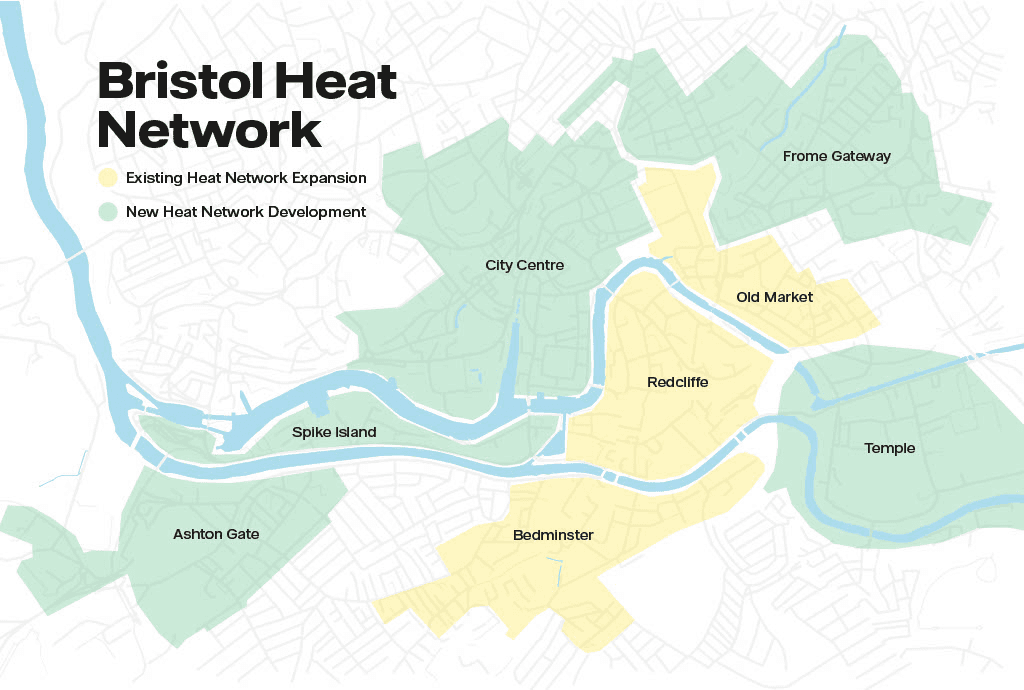
Source: Bristol Heat Network
As the city’s heat network develops, there are opportunities for collaboration between City Leap, central government and large commercial actors within the city. A collaborative approach reduces marginal costs, unlocks otherwise unviable infrastructure and maximises energy savings. As described by an employee of Vattenfall:
The Temple Quarter Enterprise campus is going to have significant compute capacity, essentially a heat pump, which will generate heat and hot water. When it's got more than it needs for the building, they’ll export it into the heat network, and when they don't have enough from those computers, they'll be importing it from us, so we have a two-way heat sharing relationship that’s extremely mutually beneficial from a commercial perspective for both parties. For all the kilowatt hours that they give to us, we're basically paying about half what we would pay if we were generating ourselves, which means we can make a bit more gross margin on that heat sale when we sell it to a customer and that can support more infrastructure development.
Jon Sankey
There are ongoing discussions between the Bristol Heat Network and both users and producers of heat. One proposal, for a connection between Avonmouth and central Bristol or South Gloucestershire that would harness currently wasted industrial heat is the subject of an ongoing feasibility study (SevernNet, 2026).
For major developments like Brabazon, the site of a New Town in North Bristol, connecting to the heat network could significantly reduce the energy and grid upgrade requirements of new homes, serving not only as a ‘nice to have, but a critical enabler’ (Sankey) for new development. While the Warm Homes Plan makes explicit mention of district heating being a key consideration for New Towns development (UK Government, 2026), there is a need for keystone institutions like City Leap to coordinate between bodies and ensure that collaboration opportunities are realised:
[…] as you can imagine, we're talking about loads of different stakeholders with their own priorities. Nothing is joined up here. Nobody's on the same page... I sat down with some folks from the [West of England] Combined Authority [WECA] that are responsible for the spatial development strategy and the new town.
I said ‘Look, which government departments are you involved in this so far?’
[WECA:] ‘Well, MHCLG [Ministry for Communities and Local Government], DfT [Department for Transport], Homes England.’
[Vattenfall:] ‘OK, where's DESNZ [Department for Energy Security and Net Zero] in this conversation? Because you've got a massive energy problem.’
[WECA:] ‘Oh, we haven't involved them yet. Can you help us involve them?’
[Vattenfall:] ‘Sure. OK.’
Jon Sankey
This quote highlights how place-based organisations can act as coordinating nodes, maximising the potential of large projects during development. The advantage of a durable partnership like City Leap is that it enables future new developments to consider heat network infrastructure from the outset:
It will be nuts to go and build a tram network, dig up all the roads and not put a heat network in at the same time. The routes are almost identical. So it's not just ‘right we need to think about energy and heat networks’. We need to join all of this stuff up across these different infrastructure vectors within this new town approach.
Jon Sankey
Conclusion
The Bristol Heat Network illustrates the city’s proactive approach to decarbonisation. Support from the city council and solid institutional foundations provide long-term security of vision. The increasing national support illustrated in the Warm Homes Plan reaffirms the role that district heating systems will play across UK cities. Given institutional and policy support for heat networks, the biggest challenge remains a persistent spark gap.
Progress continues in Bristol. City Leap understands the importance of collaboration and are seeking opportunities throughout the city from Temple Quarter to Avonmouth. The challenge is to keep moving, maximising co-benefits and ensuring long-term viability.
Thank you to Vattenfall, and to John Sankey, who was interviewed and agreed to be named for this policy insight.
References
Carbon Brief. (2025). ‘UK budget 2025: Key climate and energy announcements’. Available at: https://www.carbonbrief.org/uk-budget-2025-key-climate-and-energy-announcements/ Accessed 2 March 2026.
DESNZ. (2025b). Exploring the take-up and usage of thermal energy storage in heat networks. Available at: https://assets.publishing.service.gov.uk/media/689b163bebe5217ba73d0bfb/thermal-energy-storage-heat-networks-raf062-2324.pdf Accessed 27 February 2026.
DESNZ. (2025a). Final UK greenhouse gas emissions statistics: 1990 to 2023. Available at: https://www.gov.uk/government/statistics/final-uk-greenhouse-gas-emissions-statistics-1990-to-2023 Accessed 10 October 2025.
Innovate UK. (2023). Project REMeDY: Prospering from the Energy Revolution. Available at: https://iuk-business-connect.org.uk/wp-content/uploads/2023/06/Project-Remedy-project-fact-sheet.pdf Accessed 27 February 2026.
nesta. (2025). ‘ Price gap between gas and electricity hits highest level since energy crisis of 2022’ Available at: https://www.nesta.org.uk/press-release/price-gap-between-gas-and-electricity-hits-highest-level-since-energy-crisis-of-2022/ Accessed 2 March 2025.
Ofgem. (2026). ‘Heat networks regulation is now live’ Available at: https://www.ofgem.gov.uk/blog/heat-networks-regulation-now-live Accessed 2 March 2026.
SevernNet. (2026). ‘Portbury Avonmouth Severnside – Heat Network feasibility study’ Available at: https://severnnet.org/heat-network-feasibility-study/ Accessed 2 March 2026.
UK Government. (2022). 'Heat Networks Zoning Pilot'. Available at: https://www.gov.uk/government/publications/heat-networks-zoning-pilot (Accessed 13 March 2026)
UK Government. (2026). 'The Warm Homes Plan'. Available at: https://assets.publishing.service.gov.uk/media/696f8a3ec0f4afaa9536a0c4/warm-homes-plan-standard-print.pdf Accessed 27 February 2026.
Vattenfall Heat UK. (2025b). 'The latest low carbon energy centre joining the Bristol heat network', Vattenfall Heat UK. Available at: https://heat.vattenfall.co.uk/news-and-insights/2025/04/latest-bristol-energy-centre Accessed 23 January 2026.
Vattenfall Heat UK. (2025a). 'Heat networks could deliver a £2.1 billion step towards healthier, lower carbon communities in Edinburgh and the Lothians'. Available at: https://heat.vattenfall.co.uk/news-and-insights/2025/03/ecci-co-benefits-report Accessed 23 January 2026.